
SCADA Open Platform

Capability 04 · CMMS · Computerized Maintenance Management System

A maintenance system that needs no data entry.

The plant already knows when each machine ran, when it stopped and what the operator said about it. Maintenance should be arithmetic over that record — not a second one somebody has to keep.

Everything the maintenance system does, in one glance.

  • the maintenance board
  • the editor's maintenance room
  • the technician's phone
  • Reports
You wantWhat SOP does, and wherethe place
To know what maintenance owes you right nowThe board opens on the debt: overdue, due today, this week, later, and what the line has asked for.the board
To see the week the crew is walking intoSeven days from today, protected windows drawn as rooms, anything late pinned to today.the week
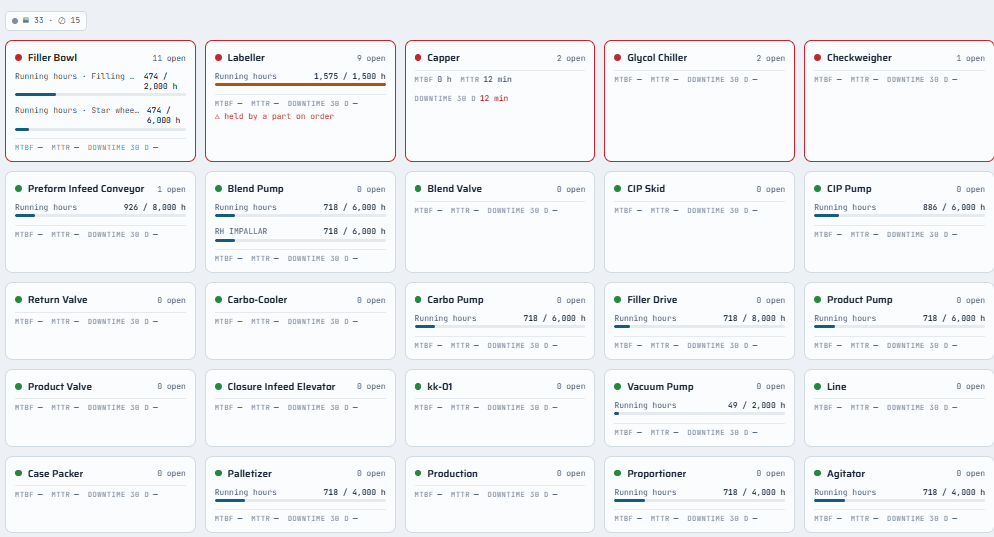
To ask which machine is hurting youOne card per machine: its open jobs, its meters, mean time between failures, mean time to repair, and the downtime behind it.the machines wall
To know whether the shelf will stop a jobShortages pinned on top, each naming the jobs it is holding.parts
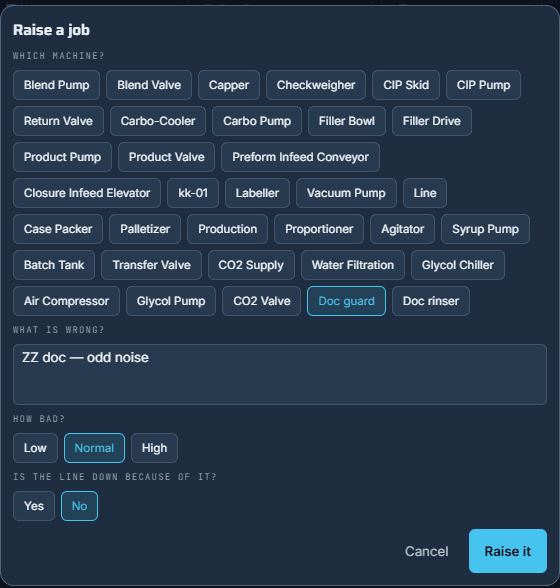
To tell maintenance something is wrongRaise it: the machine, what is wrong, how bad, and whether the line is down because of it.the board, top
To turn a stop or an alarm into tracked workCall maintenance on the restart receipt, or in the alarm acknowledgement: the machine, the moment and the reason ride along.the performance page, the alarm
To put the work in the crew's handsRelease it: the checklist freezes on the spot and a protected window is booked.the job's dossier
To do the workTake it, start it, work the steps, finish it — on a phone, with nothing installed.the job screen
To close it properlyMinutes, stopped time, what you found, why it happened, then sign.the close pane
To set a machine up in one pressChoose the machine's type and dress it: its parts, its plans, their checklists, the spares each job needs and the failure words all arrive.the editor's maintenance room
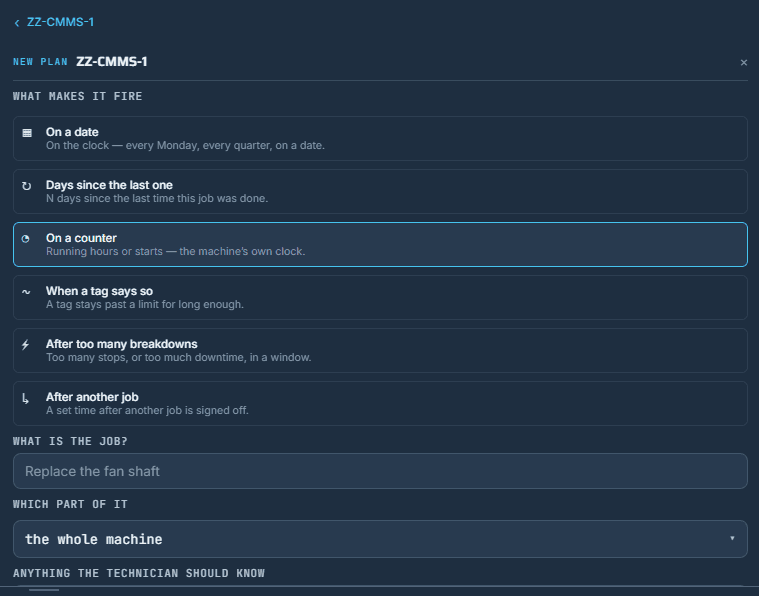
To say when a machine gets servicedOn a date, so many days since the last one, every so many running hours or starts, when a tag says so, after too many breakdowns — and one that follows a signed repair by itself.the plan pane
To catalogue a spare or move stockReceived, taken, put back, corrected: the shelf is the sum of its movements, and the whole site's ledger is one door away.the store
To prove the work was doneOn time against due, the money argument, what broke and why, and every closed job as its own sheet.the record, then Reports

Every job is born a draft. The machine and the operator propose; a supervisor releases.

01/07

The plant under it

It opens on a plant that is already there.

  • Maintenance here is not a system you feed.
  • It is arithmetic over the plant the SCADA is already writing: the same machines, the same signals, the same alarm journal, and the same history the trends read.
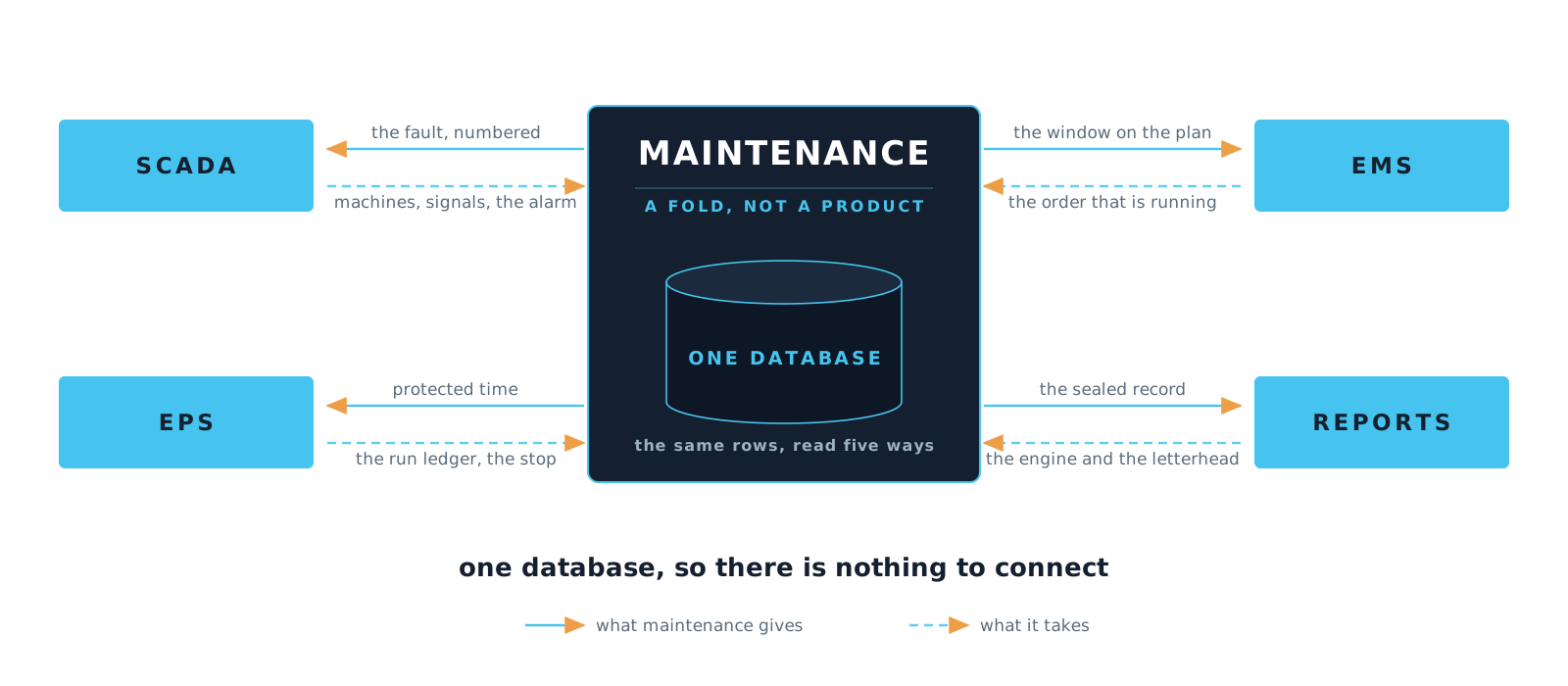
  • Maintenance is not a product beside the SCADA here; it is a fold over the same rows.

It opens on a plant that is already there:

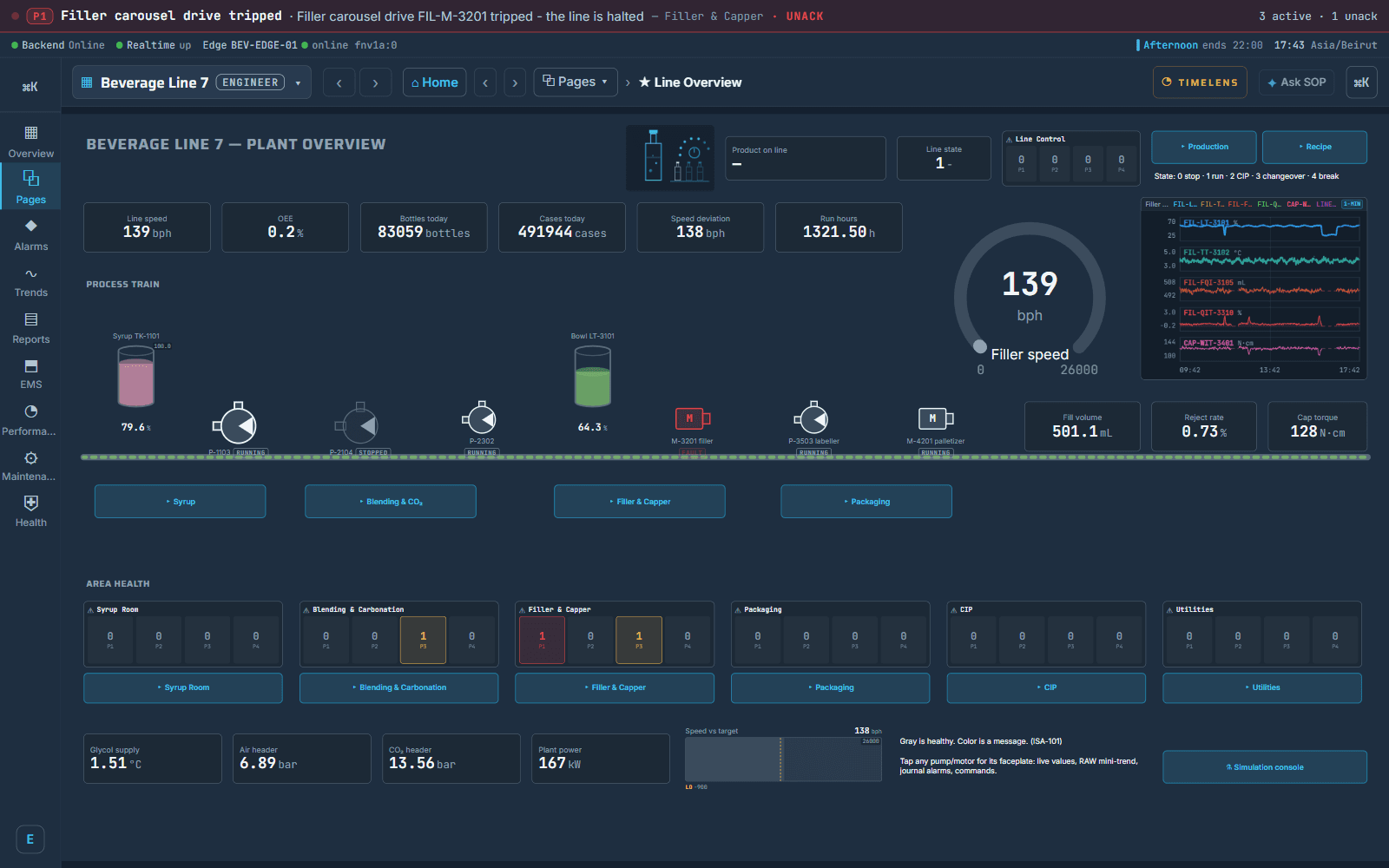
the live pages · Beverage Line 7
The live line the maintenance sits on — drawn once, served on every screen.
  1. The same pages everywhereThe same pages follow a user from the wall panel to a phone, with nothing installed and nothing licensed per screen; three languages from one design.
  2. Every machine carries its own doorTap a pump for its faceplate, its journal and its documents, from the page it stands on.
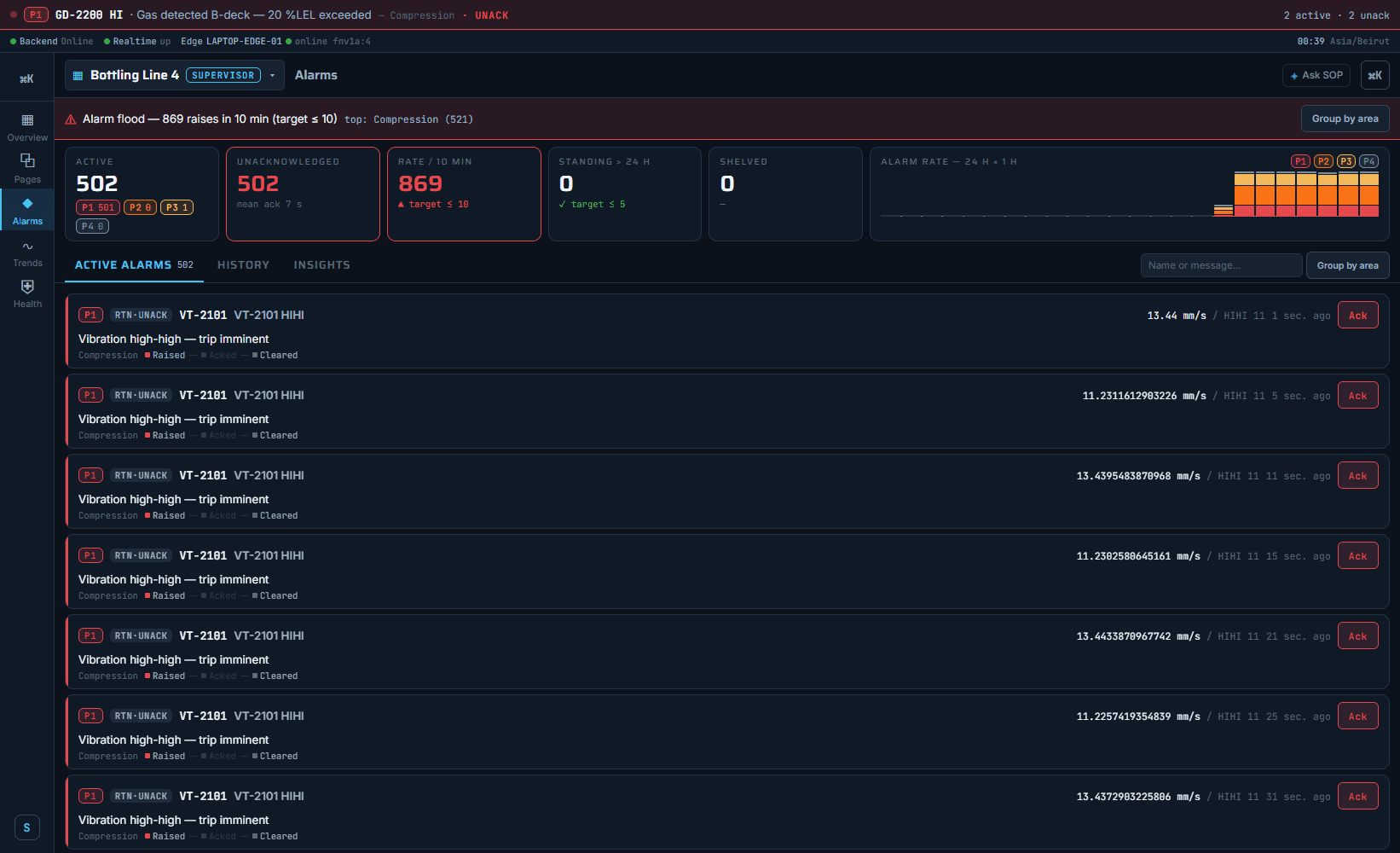
  3. The journal a fault is called fromAlarms prioritised, acknowledged, shelved with a reason, kept in a journal a tag delete cannot rewrite.
  4. The job and the alarm point at the same eventIt is the journal a fault is called into maintenance from.
  5. TimeLens replayReplays any screen from the history the plant already keeps: the alarms at that moment, commands off, the day's timeline, back to live.
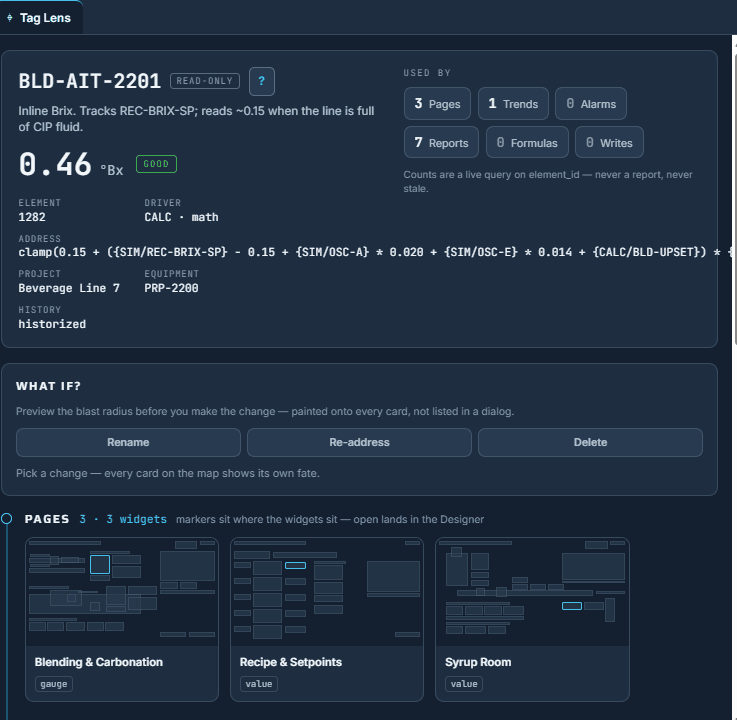
  6. The Tag LensShows where one signal is used — pages, trends, alarms, report blocks, conditions — before anybody renames it.

Seen in the product

The Tag Lens — one signal, with every page, trend, alarm, report block and condition that uses it.
TimeLens under any replayed screen — the alarms at that moment, commands off, the day's timeline, back to live.
02/07

The machine's type

One word plants the whole maintenance package.

  • A machine arrives with a code, a name and one word: its kind.
  • That word carries its parts, its service plans, the steps a fitter will work through, the spares each job will need and the words he picks from when something breaks.
  • On the screens that word is the machine's type.

Dress it from the type, in one press:

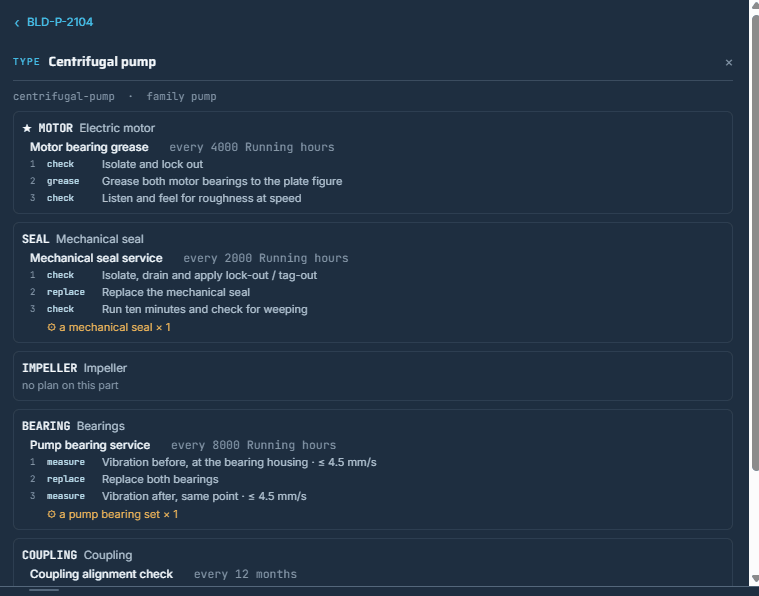
the editor's maintenance room · the type package
One press, and the machine's type hands down its parts, its plans and the words for a breakdown.
  1. Register a machine and give it its typeOne word carries its parts, its service plans, the steps a fitter works through, the spares each job needs and the words he picks from when something breaks.
  2. Dress it from the typeSets a machine up in one press: its parts, its plans, their checklists, the spares each job needs and the failure words all arrive.
  3. Parts arrive ranked by criticalityThe parts a type hands down arrive ranked by how critical each one is.
  4. Restore this type's factory partsA deleted plan comes back whole with its steps and its tolerances; a type that never had a factory set says so in plain words instead of an error.
  5. Change a machine's typeRefused while a job is open; once that job is finished or cancelled it sheds the old package and takes the new one.
  6. The delete dialog names the lossesIt names everything that would die with a machine before you press it.
  7. Not a maintained assetA vessel or a meter point leaves the maintenance wall and every machine count, and stops reading as somebody's missed maintenance.
  8. Change the interval on the machineThe library is a starting point, never a rule: dressing again is additive, and no interval you changed is ever put back.
  9. The type's own failure wordsAt the close the cause list is that machine's own, so the ranking of what breaks is never diluted by words somebody typed.
  • The type copies, it never lends: change the library afterwards and nothing already dressed moves.
03/07

Meters and plans

A meter nobody types cannot drift.

  • Running hours and start counts are not typed here.
  • They are folded from the line's own record of when it ran and when it stopped, so a plan fires on what the machine actually did — not on what somebody remembered to write down.

Say when a machine gets serviced:

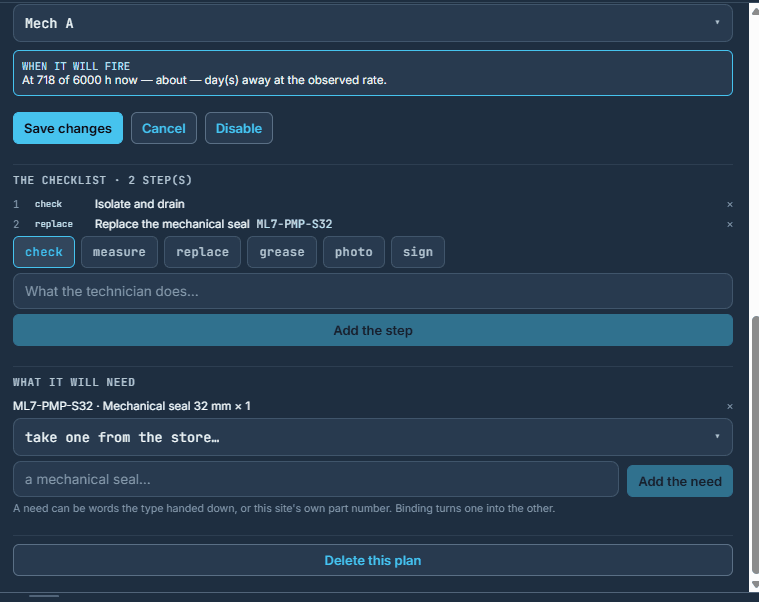
the plan pane · when it will fire
The plan says when it will fire, and the same arithmetic that raises the job draws the preview.
  1. Meters that keep themselvesRunning hours and starts keep themselves, every shift, with nobody asked and nothing to remember.
  2. Correct the offset onceEvery total since corrects itself, and the last-service mark moves by the same amount, so no plan fires early.
  3. A machine with no signal of its ownIt works the same plan grammar from a number a person read off it.
  4. Five ways a service comes dueOn a date; a set number of days after the last one; every so many running hours or starts; when a signal on the line says it is owed; once a machine has broken down too often.
  5. The follow-up born from a signed repairBorn only when something was actually found; never scanned for and never guessed.
  6. The preview cannot disagree with the engineThe next due date is previewed by the same arithmetic that raises the job.
  7. A meter plan's due date reads estimatedIt is projected from the rate the machine is actually running at.
  8. A plan with an open job stays quietNo second job while the crew is still on the last one, and every job it raises is born a draft for a person to release.
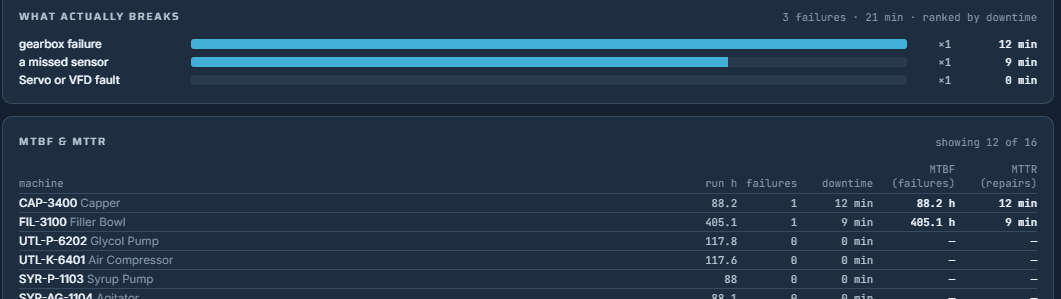
  9. The machines wallOne card per machine: its open jobs, its meters, mean time between failures, mean time to repair, and the downtime behind it.

Seen in the product

The ways a service comes due, as the plan pane offers them.
The machines — every machine's open jobs, its running hours against the next service, mean time between failures and mean time to repair.
04/07

From fault to job

The stop becomes the job in one tap.

  • A fault that stays in a conversation is a fault nobody can count.
  • Here the stop, the alarm and the operator's own words all become the same numbered job — and a supervisor decides what happens to it.

Turn a stop or an alarm into tracked work:

the board · raise a job
The door a fault becomes a numbered job through.
  1. The board opens on the debtOverdue, due today, this week, later, and what the line has asked for.
  2. The week the crew walks intoSeven days from today, protected windows drawn as rooms, anything late pinned to today.
  3. Raise itTell maintenance something is wrong: the machine, what is wrong, how bad, whether the line is down because of it.
  4. Call maintenance from a stopTurns a stop into tracked work: the machine, the moment and the reason ride along, nothing retyped.
  5. Call maintenance from an alarmThe same request carrying the alarm itself, so the job and the alarm can never point at different events.
  6. Make it a jobTurns a real ask into a numbered work order; a request with no machine named is refused until one is.
  7. Release does three things at onceThe checklist freezes from the plan, the job goes to a name, and a protected window is booked when the job genuinely stops the line and the plant has left that switch on.
  8. Cancel the job, with a reasonThe reason is demanded, and the record keeps it next to who cancelled it and when.
  • An ask is not a job: nothing is scheduled, nothing is counted and nobody is assigned until a supervisor turns it into one.

Seen in the product

The alarm a fitter is called from.
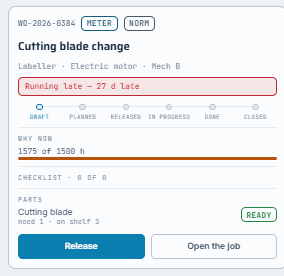
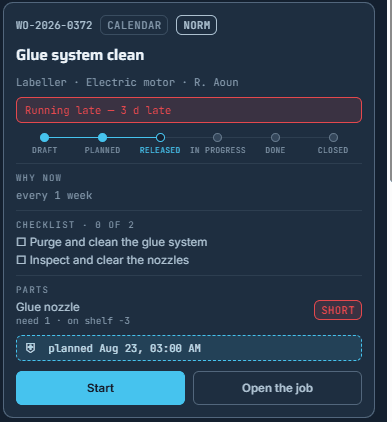
One job opened — why now, the checklist that will freeze, the part the shelf is short of, one press to release.
05/07

The technician's phone

The phone is the technician's whole tool.

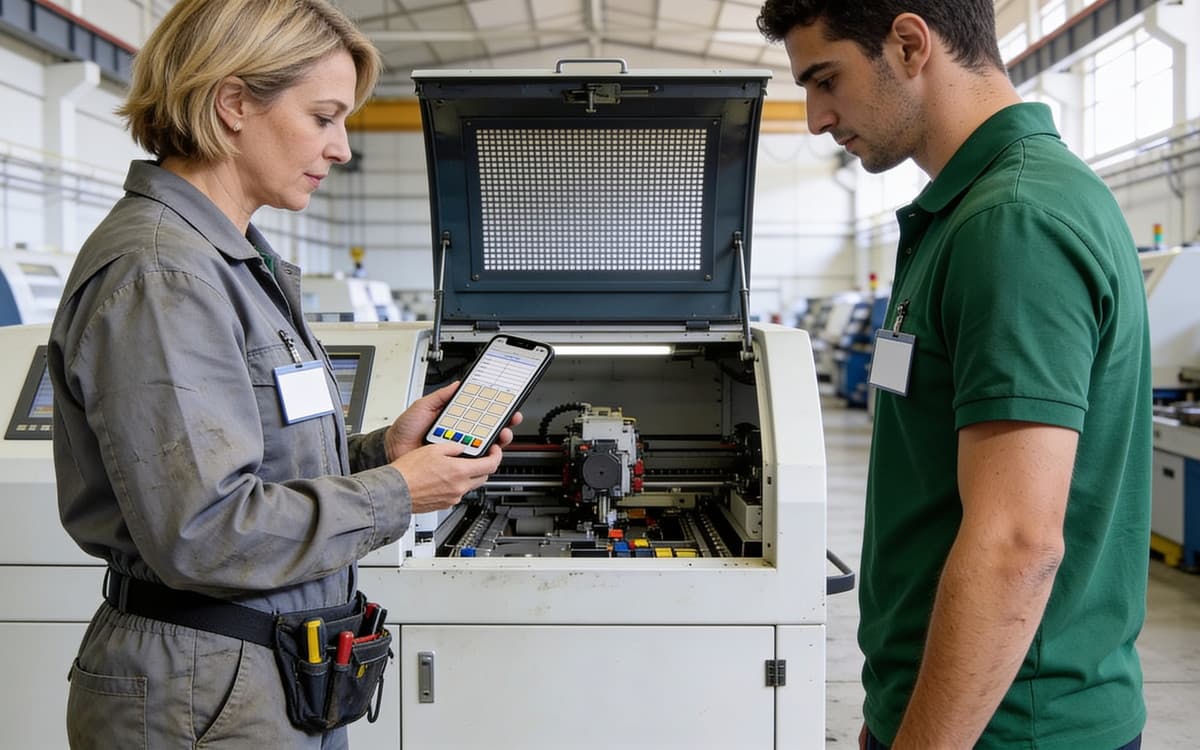
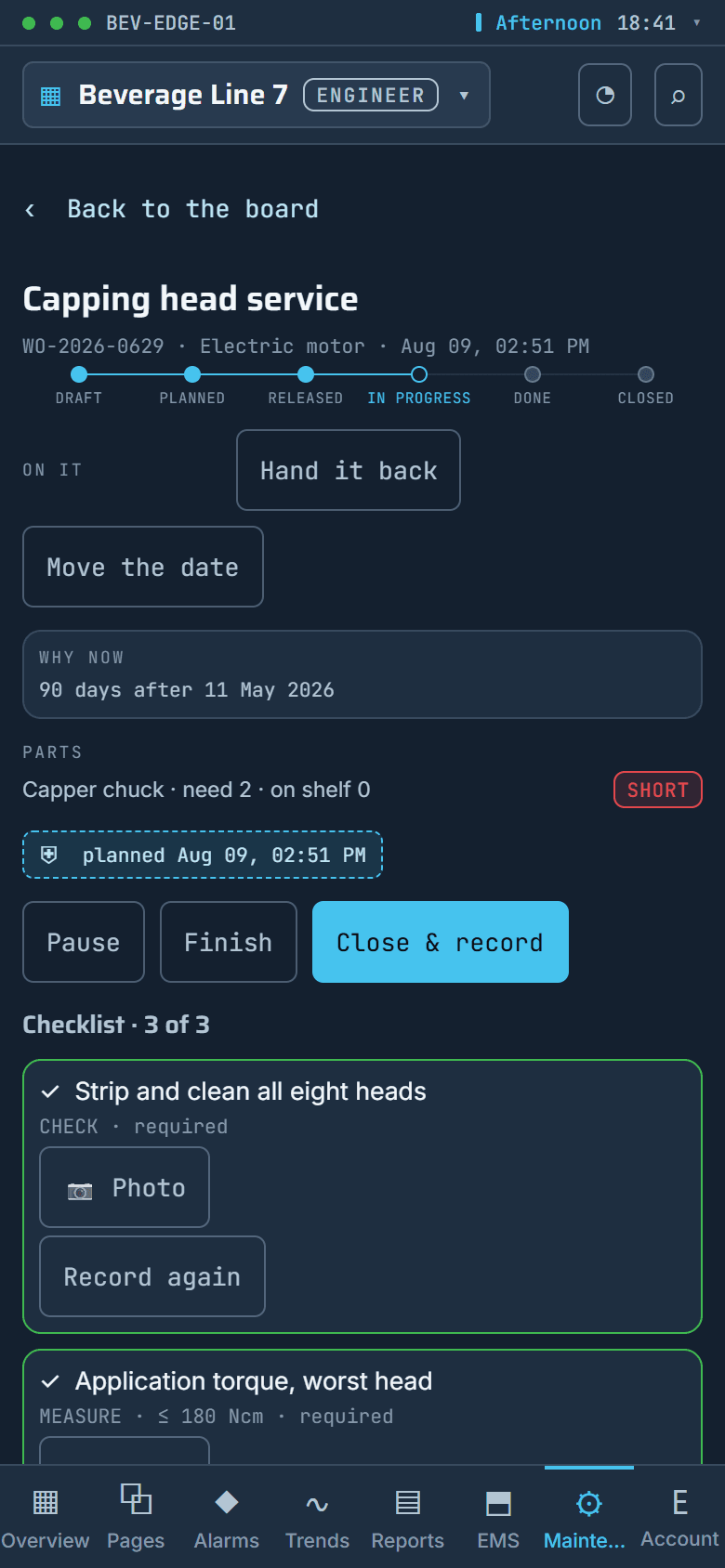
  • The same application, sized for a hand: nothing to install, nothing licensed per screen, and nothing filed later.
  • Every press writes at once.

Take it, start it, work it, finish it:

the job screen · on a phone
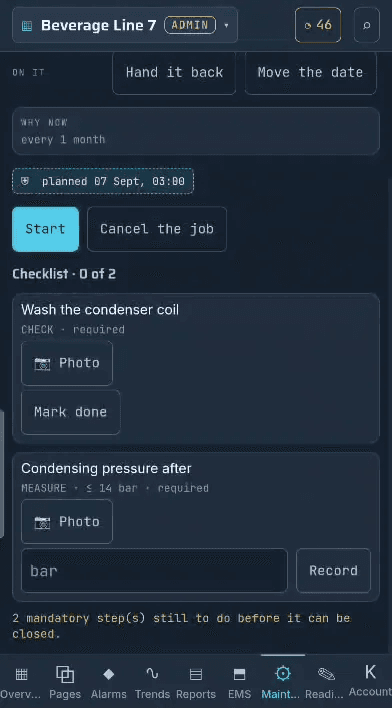
The frozen checklist with its readings, in a fitter's hand.
  1. Filter to mineHis jobs, late first, each with its machine, why it is due and what the plan expects to find on the shelf.
  2. I'll take itThe job is his; a take can only ever point at the person pressing it, and the name is the state, so there is no badge to look for.
  3. A reading judged at the boxA measurement with a limit is judged in red before anything is sent.
  4. A failed step blocks the closeThe job cannot be closed while a required step is failed or unfinished.
  5. Take a spare from the stepStock moves there and then against this job: no confirmation, no quantity box, no partial take, exactly what the plan froze.
  6. The store's own words when the shelf is shortThe store answers the take in its own words instead of failing quietly.
  7. A photograph on the stepFiled with the job and readable for ever; a wrong photograph is answered with a better one, never removed.
  8. Finish, then close and signThe close books the minutes, prices the labour from the line's own rate, books the parts, moves the counters, records what broke and why, and seals the record.
  • The checklist freezes at release, so a plan edited next month never rewrites work already in flight.

Seen in the product

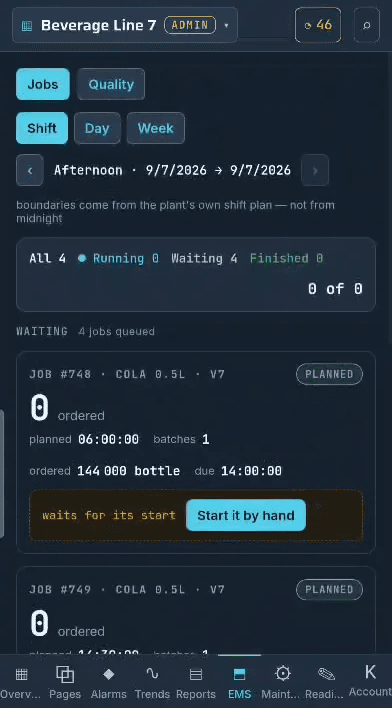
The jobs board on a phone — the filters, the job rows.
Finishing and closing a job where the machine is.
06/07

Parts and the shelf

The shelf answers before the technician walks to it.

  • The store is not a number somebody keeps up to date.
  • Stock is the sum of every receipt, issue, return and correction — so the shelf can answer a job before the crew is sent to do it.

Catalogue a spare or move stock:

the store · what a job will be short of
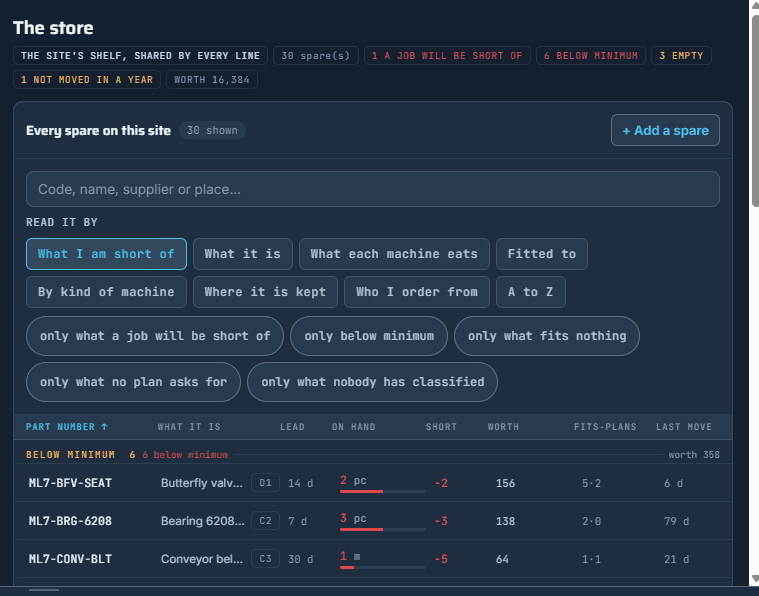
The store, read by what a job will be short of.
  1. Parts held against the shelfA job's expected parts answer ready or short before anyone walks anywhere, with the quantity the plan asked for.
  2. Shortages pinned on topEach names the jobs it is holding, with its bin and its family.
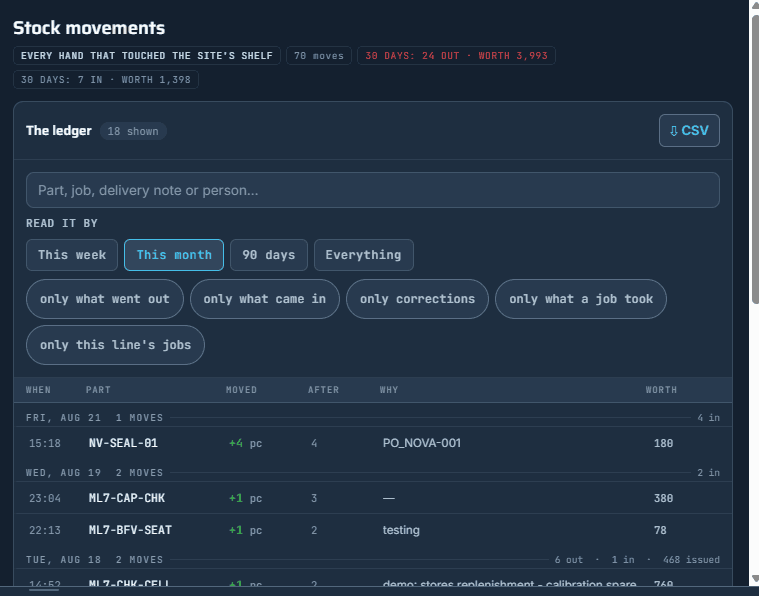
  3. Record a movementReceived, or corrected with a note: the shelf moves and the running balance shows it.
  4. The ledger refuses edits and deletesA mistake is corrected by a movement that says so.
  5. Bind the need to the spare“A mechanical seal” becomes this site's part number and quantity, and the picker puts what this machine actually eats at the top of the list.
  6. A spare that belongs to one lineIt leaves every other line's store, its stock report and its shortage count.
  7. Stock movements, the whole site's ledgerNewest first, by day, with the job, the delivery note and the person — and a spreadsheet in one press.
  • One shelf per site, shared by every line on it, unless a spare is marked as belonging to one line only.

Seen in the product

Every hand that touched the shelf — what moved, against which job, and who.
The job's dossier — why now, the checklist that will freeze, the part the shelf is short of.
07/07

The record

A record nobody signed is a note.

  • Every close writes a record the plant can hand over: designed once, computed on the server, frozen, numbered, sealed, signed, and printed on the plant's own letterhead.

Prove the work was done:

the maintenance review · as it prints
The monthly review as SOP prints it, on the plant's own letterhead.
  1. 01 DesignBlocks bound to real rows: the checklist and its readings, the parts a job consumed, done against due, what broke, and each machine's reliability.
  2. 02 ComputeOn the server, in the plant's own clock: as each maintenance job closes, every week, every month, or over the range an auditor names.
  3. 03 SealFrozen on arrival, numbered, fingerprinted; run it again and you have a second document beside the first, never a refresh.
  4. 04 SignBy name and capacity, proved with the signer's own password, bound to the fingerprint, never edited and never withdrawn.
  5. 05 DeliverPrinted on the plant's letterhead in three languages, e-mailed to the list, filed as a PDF, exported as a spreadsheet.
  6. 0 report serversThe engine runs on the backend already installed; a small worker files the PDF and posts it.
  7. 0 third-party licencesNo reporting product, no rendering licence, no designer bought separately.

The sheets a maintenance manager is judged on

  • The maintenance record — One job on one sheet: its checklist, its readings against their limits, the parts it used and the signature.
  • The week ahead — What falls due, what is already late, and what part is missing.
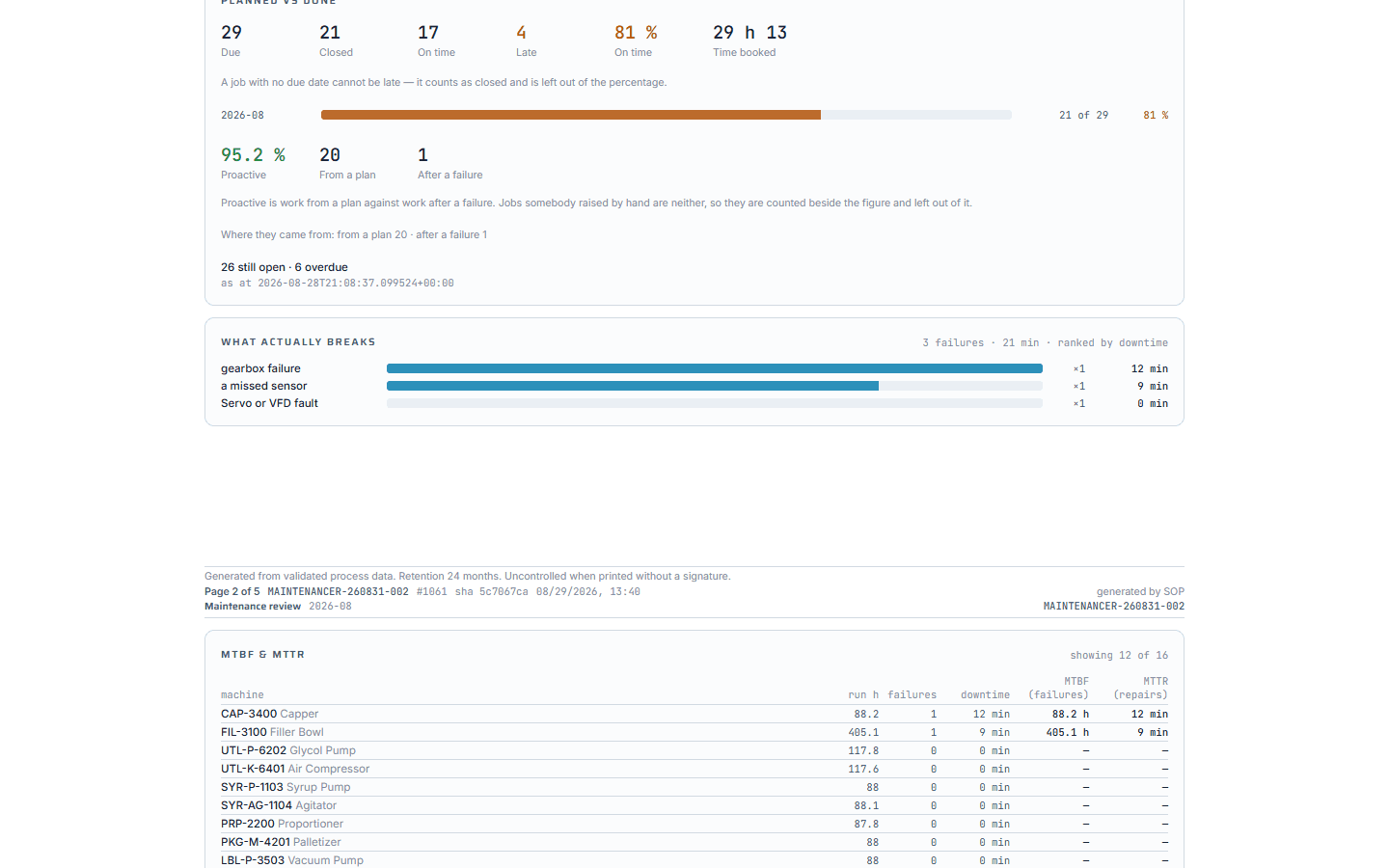
  • The maintenance review — Done against due, what broke, mean time between failures and mean time to repair, what it cost and who did the work.
  • Bad actors — The worst machines and the worst causes, ranked by the downtime behind them.
  • The audit sheet — The same numbers narrowed to the machines a person ticked; critical equipment is a list a person ticks, not a flag the software keeps.
  • Nothing on the sheet is typed — Labour from the minutes the job booked and the line's own rate, parts from the ledger as they were priced the day they were issued.
  • A dash, and how many — Where a figure was never given the sheet prints a dash and says how many, never a confident zero.
  • A signed record stays as signed — Or it becomes an openly unsigned one.

Seen in the product

The one-job record — numbered, sealed, with the machine, the part and where the job came from.
The month as maintenance is judged on it — what actually breaks, and reliability per machine.

And what no other platform does like us

  1. It opens on a plant that is already thereMaintenance is not a system you feed; it is arithmetic over the plant the SCADA is already writing, on the same rows.
  2. One word plants the whole maintenance packageThe machine's type carries its parts, its plans, their checklists, the spares each job needs and the failure words — and the type copies, it never lends.
  3. A meter nobody types cannot driftRunning hours and starts keep themselves from the line's own record; correct an offset once and every total since corrects itself.
  4. The stop becomes the job in one tapFrom the restart receipt or from the alarm acknowledgement, so the job and the alarm can never point at different events.
  5. The phone is the technician's whole toolNothing to install, nothing licensed per screen, nothing filed later: every press writes at once.
  6. The shelf answers before the technician walks to itStock is the sum of its movements, shortages pinned on top naming the jobs they hold, and the ledger refuses edits and deletes.
  7. A record nobody signed is a noteComputed on the server, frozen, numbered, sealed, signed by name and capacity, never edited and never withdrawn — with no report server and no second database.
  8. Nothing to connect, because there is nothing to connectA released job books a protected window the performance engine already honours, on the same plan the production orders are laid out on; no meter to transport, no asset register to type, and no nightly job that copies yesterday's plant into a second database.
  • None of this is an interface between products. It is the same rows, read four ways, under one security model that reaches the printed sheet.