
SCADA Open Platform

Capability 03 · Equipment Performance System

Lost hours stop being an opinion. Every one has a name.

One database for the whole plant. The line's own run signal and its own counters are worked out once, on the server — and every lost hour walks back to a minute, a machine and a person's word about what happened.

Everything this module does, and where you press for it:

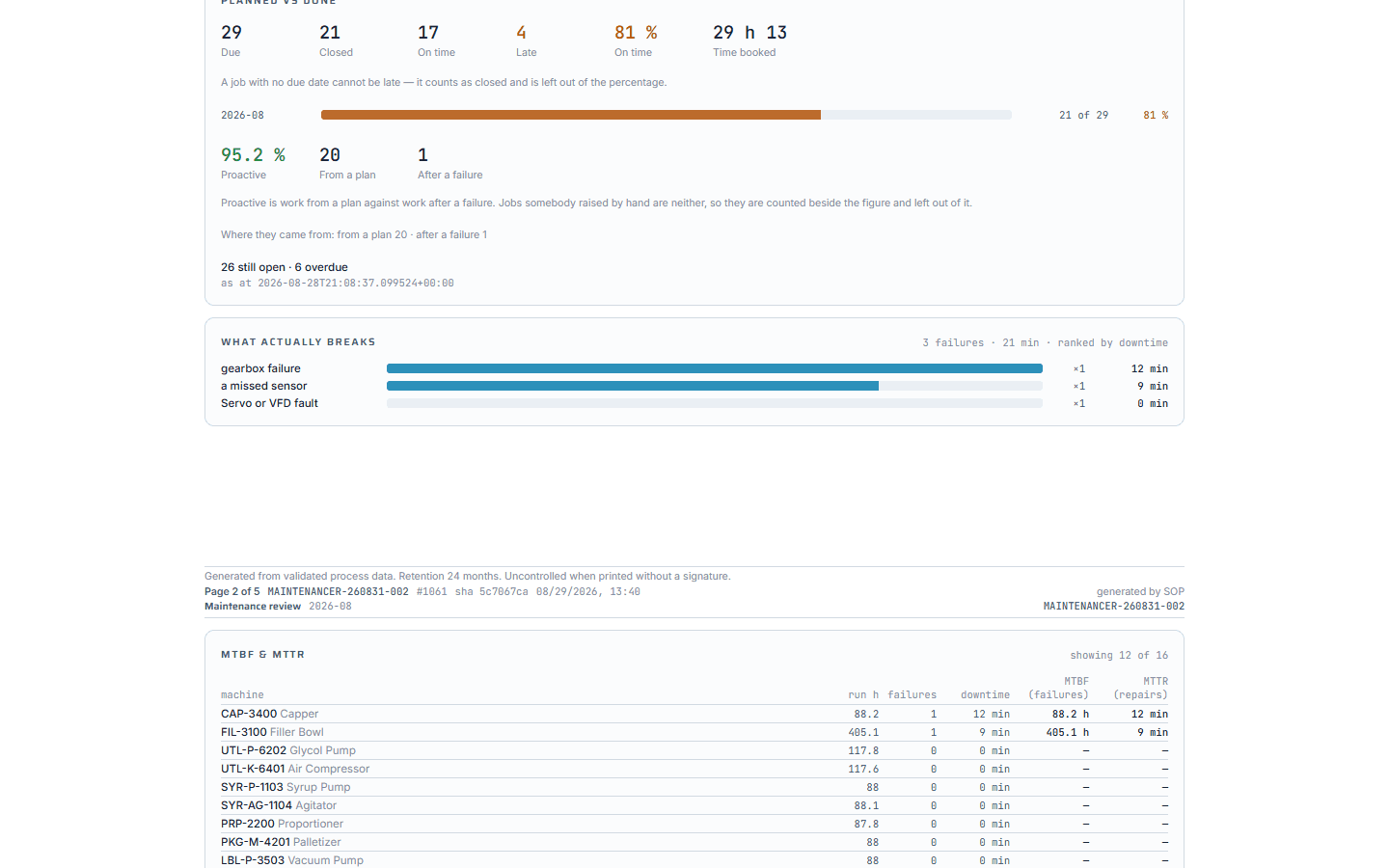
EPS · Beverage Line 7 · the period sheet
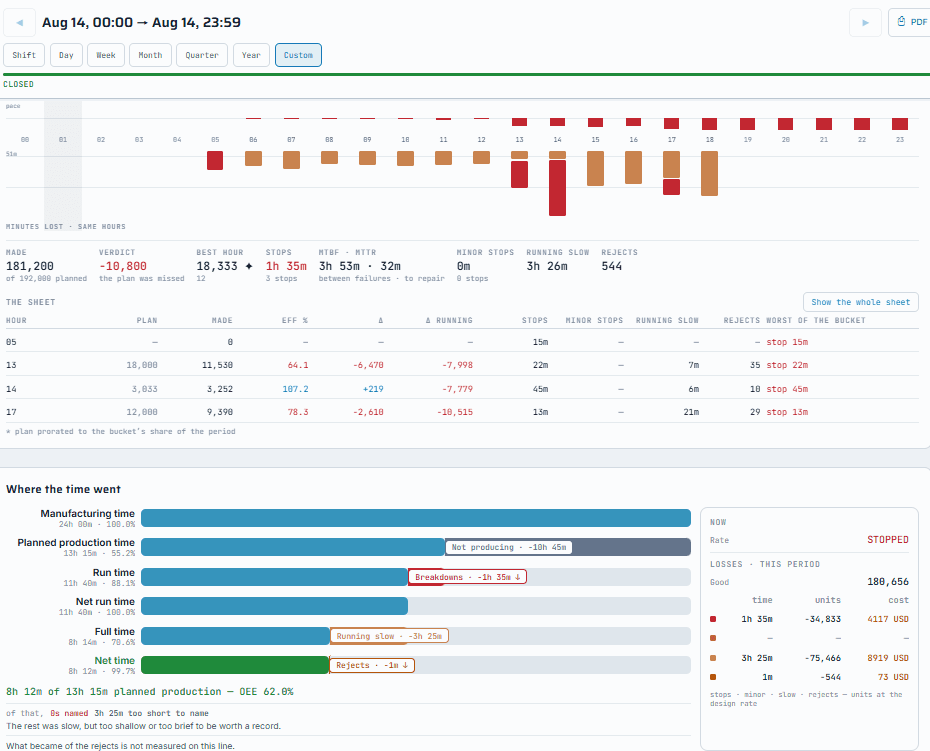
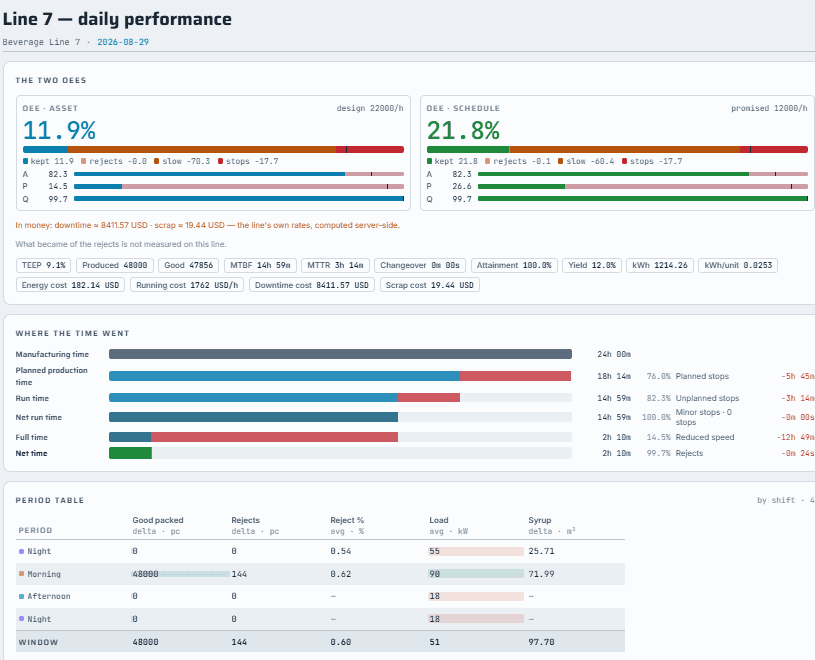
One day on one line · the minutes lost hour by hour, the verdict against the plan, and where the time went — six bands, in minutes and units
  1. One calculation, on the server, for every screenthe wall tile, the synoptic, the report block and the exported table are the same arithmetic and cannot disagree.
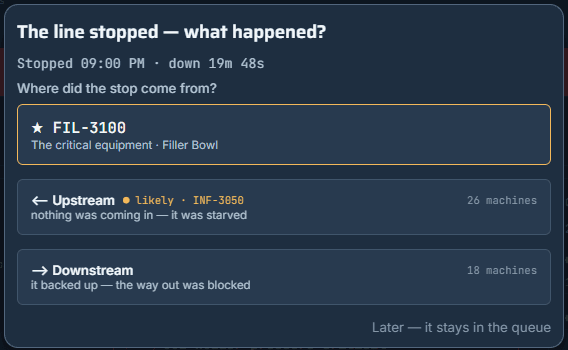
  2. The stop is named at the restart, in two tapsnobody is interrupted while the line is down, and the short stops are never a popup.
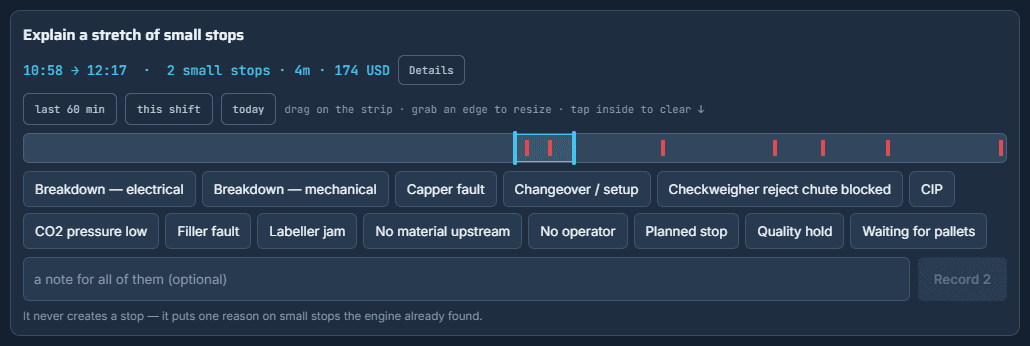
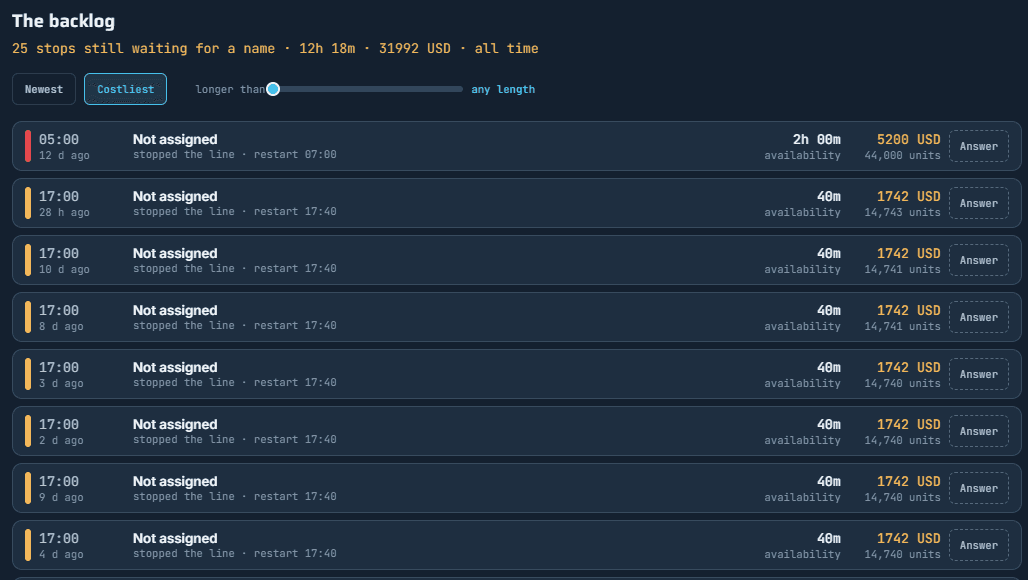
  3. A backlog no period can hideevery unnamed stop from commissioning to this minute, ranked by what it cost; forty small stops named in one drag.
  4. Two honest OEEs over any windowwhat the machine could have made, and whether the jobs met the rate their own recipe promised; one number cannot answer two fair questions.
  5. Six bands turn a bad percentage into minutes, units and moneythe four loss families ranked in one glance; breakdowns, longest first.
  6. Quality counts the first pass, every timea signed verdict restates without erasing; nothing anybody wrote is ever quietly removed.
  7. A dash, never a flattering zeroa planned wash or a released maintenance job leaves the availability number; doing the right thing stops being punished.
  8. The shift printed, sealed and signed in one pressfrom the same engine as the batch certificate.

What you want to know, and where it is.

  • You want
  • What SOP does
  • Where you press
You wantWhat SOP doesWhere you press
To know how the shift that just ended wentNothing to press: the page opens on the last window that finished, never on the one being lived.the top of the performance page
Yesterday, last week, this month against lastPress the kind you want, then walk back with the arrow.the period dial
The four hours around a trip, a wash-up or a trialCustom, pick the two ends, Apply.the dial's own picker
To judge one product run start to finishTap the job in the jobs table and the whole page becomes that job.jobs in this period
To know whether the period went well at allRead the Asset card and its strip; the longest cut is the thing to chase.the two OEEs
To know whether the jobs met the rate their own recipe promisedRead the Schedule card beside it.the two OEEs
To turn a bad percentage into minutesRead the six bands, top to bottom.where the time went
To know what those minutes cost in units and moneyRead the losses card across a row to price one loss, down the cost column to rank them.losses, this period
To know which hour of the day hurtRead the board's bars, or its sheet, worst first.the hour board
To know whether you are going to make the planRead the chips: made so far, where that leaves you against plan, and where the recent pace lands.under the bars
To know which single stop hurt mostBreakdowns, sorted longest.the stop rooms
To name a stopTap the card, tap a reason, Record.the backlog
To name forty small stops at onceDrag the stretch, one reason, Record.the stretch panel
This window on paper, signed and filedThe PDF button on the dial.the top of the performance page

Every window is measured in the site's own clock, and a window that is still running says so out loud instead of pretending to be finished. Nothing on the page is set here: every dial it reads is declared once on a plant screen, and this page only reads.
01/08

One calculation, every screen

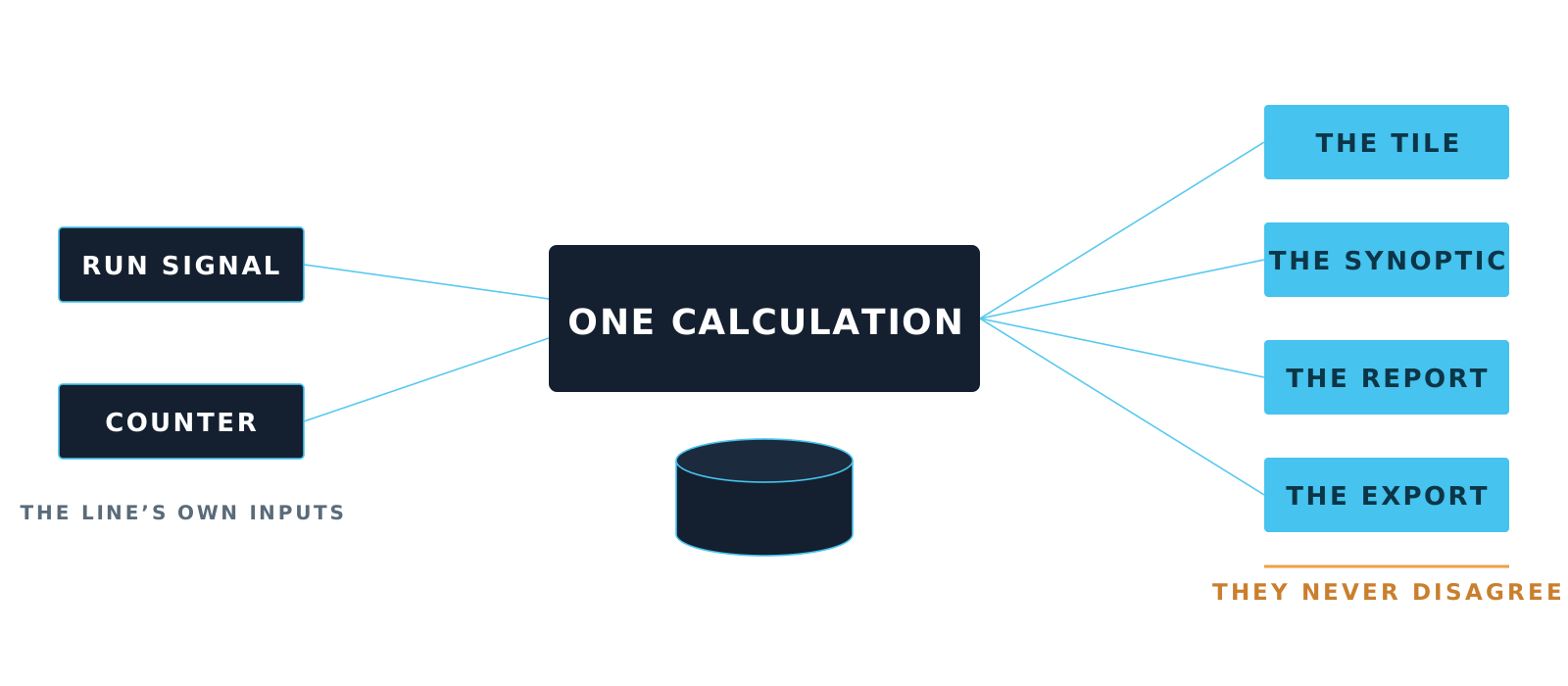
one calculation on the plant's own rows, and four faces that read it

The run signal and the counterthe whole input, on the left
One calculationworked out once, on the server
Four facesthe tile, the synoptic, the report, the export
They never disagreejoined to the centre and to nothing else

One calculation, on the server, for every screen.

  1. One calculation, on the serverThe run signal and the counters are worked out once; the wall tile, the synoptic number, the report block and the exported table are the same arithmetic and cannot disagree.
  2. Nothing new wiredPoint the module at the run signal the SCADA already shows: the performance number comes from signals the plant already has, and no code on the edge.
  3. A run signal but no counterMark the critical machine and leave the rest: availability, honestly, and a dash wherever a count is needed.
  4. A corrected old readingCorrect it where it was declared and every total that used it corrects itself, back through the history.
  5. The numbers on the operator's own pageAn engineer drops the performance tiles on a synoptic, so the figure lives on the screen the operator already watches.
  6. A dash, never a flattering zeroA figure the plant never declared prints as a dash, and one screen names the machine still missing a figure.
  7. The number, the screen and the recording are one recordThe run signal is the one the SCADA already shows, and TimeLens replays that same page from the historian at any moment you name.

One calculation, on the server, for every screen.

  • The line's own run signal and its own counters are the whole input, and they are worked out once, on the server. The tile on the wall, the same number dropped on a synoptic, the block in a report and the exported table are therefore the same arithmetic, and cannot disagree.
  • The performance number comes from signals the plant already has, and no code on the edge.
  • The run signal is the one the SCADA already shows on the operator's page, and TimeLens replays that same page from the historian at any moment you name. The number, the screen and the recording are one plant record.
  • Every total that used it corrects itself, back through the history.
02/08

Stops and the reason

Asked once, at the restart, in two taps.

EPS · Beverage Line 7 · the restart card
the card that opens by itself when the line comes back: which side did it come from, then the machine
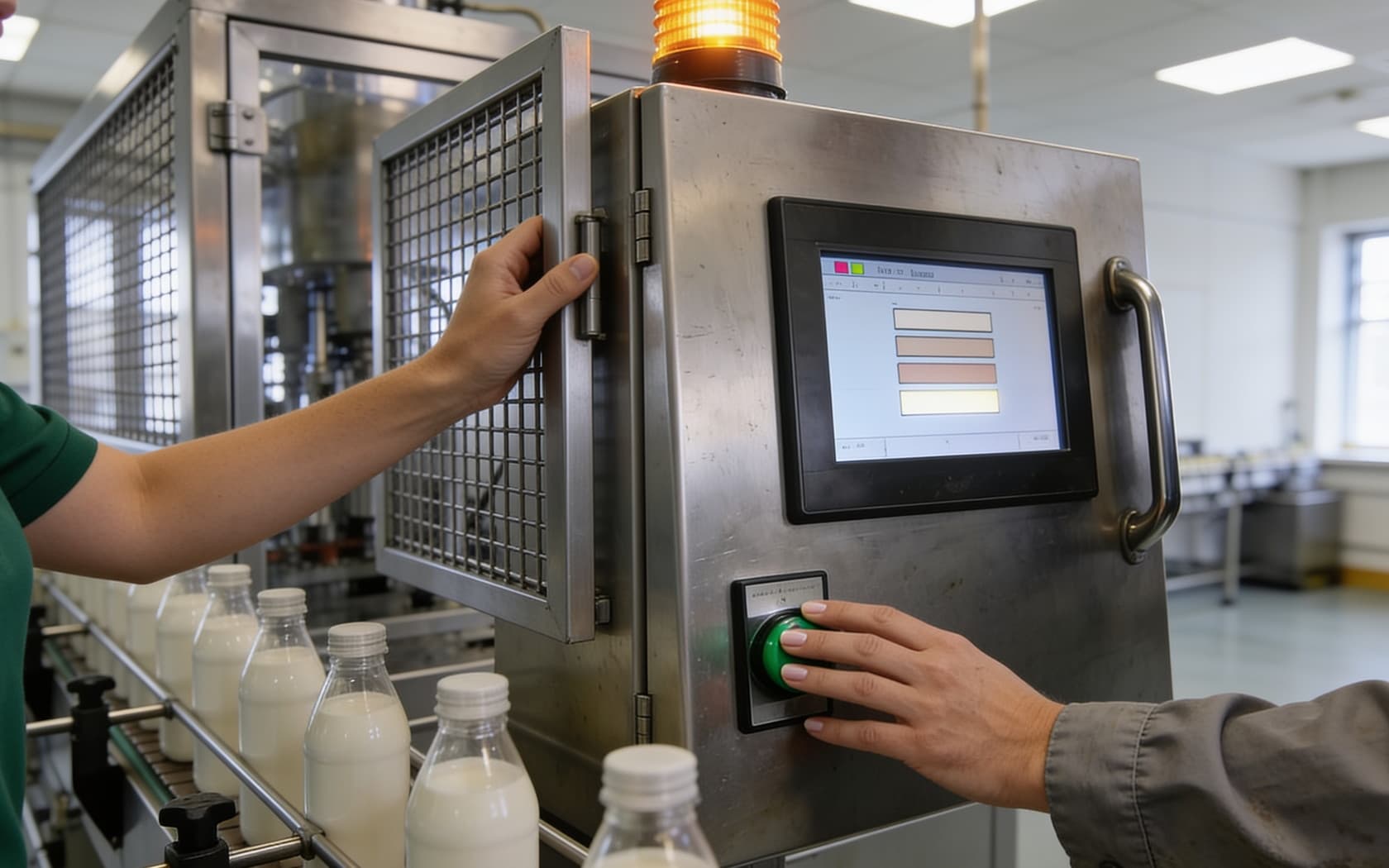
  1. The card that opens at the restartThe line comes back, the operator has just cleared the cause, and the card is already open — named in two taps.
  2. This machine's own reasonsTap one, then Record: the stop leaves the list, named, with who said so and when.
  3. Another machine caused itMore reasons, then the side it came from, then the machine, the kind and the cause — the loss is filed against the machine that caused it, not the one that stopped.
  4. No word for it yetType it in the box and record it as other: an honest record of a stop nobody can name, instead of a wrong reason on the sheet.
  5. LaterThe operator still firefighting presses Later: the stop waits in the backlog, nothing is written, and nobody is told he looked.
  6. Small stops are never a popupA stop too short for anybody to reach counts against the number with no clicks, and gets named a stretch at a time.
  7. A stop inside a planned window never asksPlanned time stays planned, and the availability number is not punished for a wash.
  8. Naming a calendar-filed stopNaming it turns it back into an unplanned stop and its time re-enters the number — a person's call, not a calendar's.
  9. The three doors from the listThe same three doors answer a stop later, from the list, when the answer did not come at the restart.

Asked once, at the restart, in two taps.

  • The line comes back, the operator has just cleared the cause, and the card is already open. Nobody is ever interrupted while the line is down, and the short stops are never a popup.
  • The loss is filed against the machine that caused it, not against the one that stopped.
  • Naming a stop the calendar had filed by itself turns it back into an unplanned stop, and its time re-enters the number. That choice belongs to a person, not to a calendar.
  • An honest record of a stop nobody can name, instead of a wrong reason on the sheet.
03/08

The backlog

A backlog no period can hide.

EPS · Beverage Line 7 · a stretch of small stops
one drag across a bad afternoon, one reason, and the count before the write
EPS · Beverage Line 7 · the backlog
the backlog, all time: the stops still without a name, dearest first
  1. The backlog, all timeEvery stop nobody has named waits in one list, from commissioning to this minute, ranked by what it cost; change the period and the list does not move.
  2. Forty stops in one dragDrag the stretch, pick one reason, Record: forty records named in one act, with the count and the cost shown before the write.
  3. Change a hurried answerThe correction sits beside the first answer, both kept, with who wrote each and when.
  4. What twenty minutes of naming is worthThe top three rows carry the plain figure, and a ranking the morning meeting can argue with.
  5. The data-quality cardFinds the stops where the crew's machine differs from the machine the engine suspected — the crew tapping the first reason on the list.
  6. The disagreement cardWhen the line and the plan disagreed about a stretch of the shift, the person entitled to say so files that time as what it really was.
  7. An unnamed stop from last TuesdayStill there, still carrying its cost: no period can hide it.

A backlog no period can hide.

  • Every stop nobody has named waits in one list, from commissioning to this minute, ranked by what it cost. Change the period and the list does not move, because the whole point of a backlog is that no window can hide it.
  • Forty records named in one act, with the count and the cost shown before the write.
  • The disagreement card is the one thing here answered once and for good; everywhere else the first answer stays on the record and the correction sits beside it.
  • The correction beside the first answer, both kept, with who wrote each and when.
04/08

Two OEEs, any window

Two honest OEEs, over the window you choose.

EPS · Beverage Line 7 · daily performance
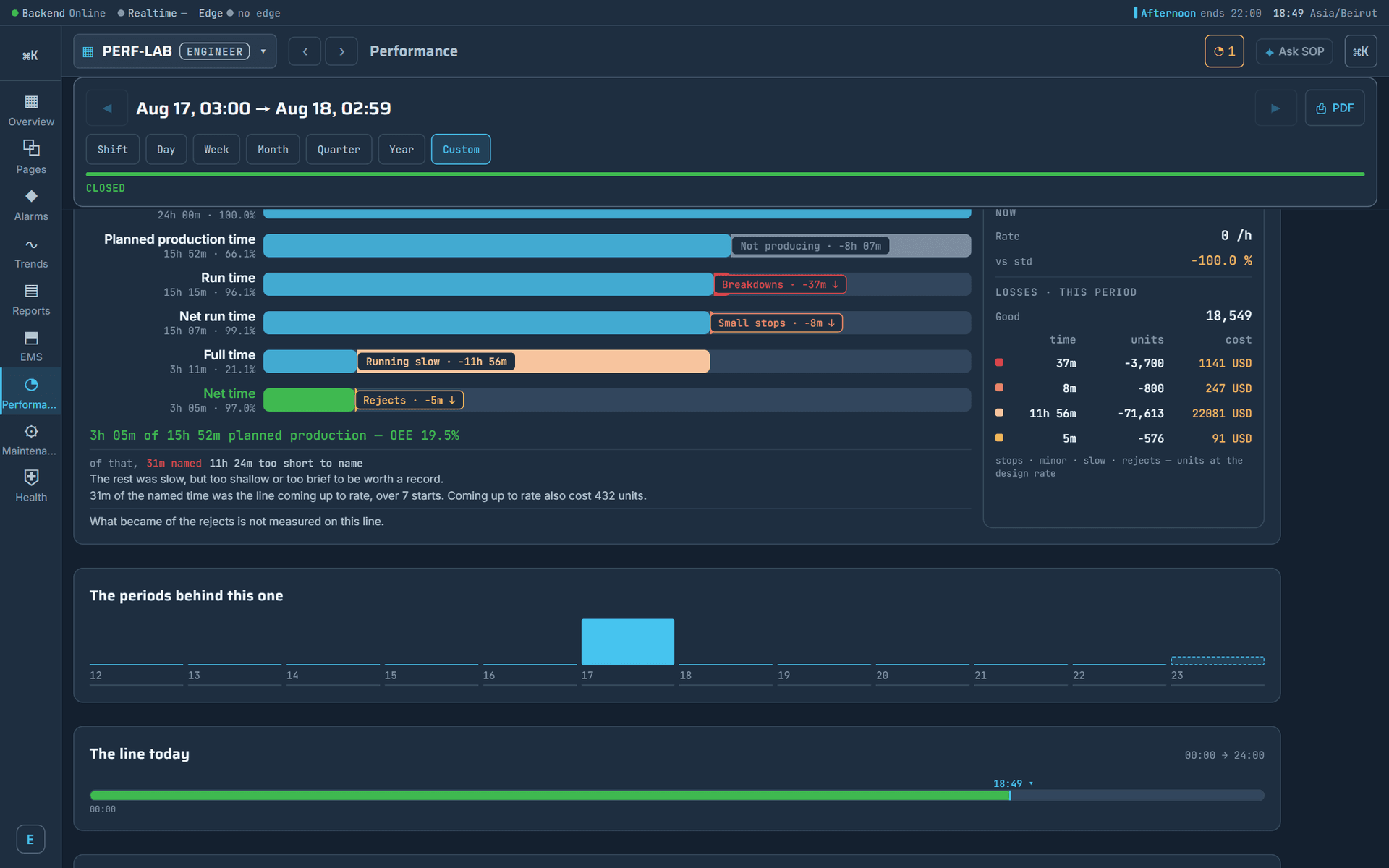
the daily performance page: the two OEE cards with their A, P and Q bars, the chips of the day, the bands of where the time went, and the period table by shift
one day of the line on one page: the two OEEs side by side, where the time went, and the period table by shift
  1. The page opens on the last finished windowNever on the one being lived — a number that can be judged instead of a half-lived one.
  2. The period dialPress the kind you want — shift, day, week, month — then walk back with the arrow.
  3. Custom, two ends, ApplyAny window from a few minutes to a year, cut by hand — the four hours around a trip, a wash-up or a trial.
  4. One job becomes the pageTap the job row and the whole page becomes that job, judged against the rate its own recipe promised.
  5. Asset OEEWhat the machine could have made; read the Asset card and its strip — the longest cut is the thing to chase.
  6. Schedule OEEWhether the jobs met the rate their own recipe promised; read the Schedule card beside it.
  7. Two numbers, both trueOn a mixed period a low machine number sits beside a comfortable plan number, and both are true.
  8. A running window says so out loudThe time played so far, and a warning that these figures will move.
  9. Running empty is never running slowAnd a window the line has no figures for says so rather than printing a zero.

Two honest OEEs, over the window you choose.

  • One number cannot answer two fair questions, so the page prints both: what the machine could have made, and whether the jobs met the rate their own recipe promised. Everything on the page obeys one window, and the page opens on the window that has just finished.
  • A low machine number beside a comfortable plan number, and both are true.
  • Running empty is never counted as running slow, and a window the line has no figures for says so rather than printing a zero. A mixed day needs both numbers, and neither of them is the flattering one.
  • Any window from a few minutes to a year, cut by hand — and a number that can be judged, instead of a half-lived one.
05/08

Quality, first pass

Quality counts the first pass, every time.

EPS · Beverage Line 7 · the reject count
where the reject count came from, and whether it has been restated since
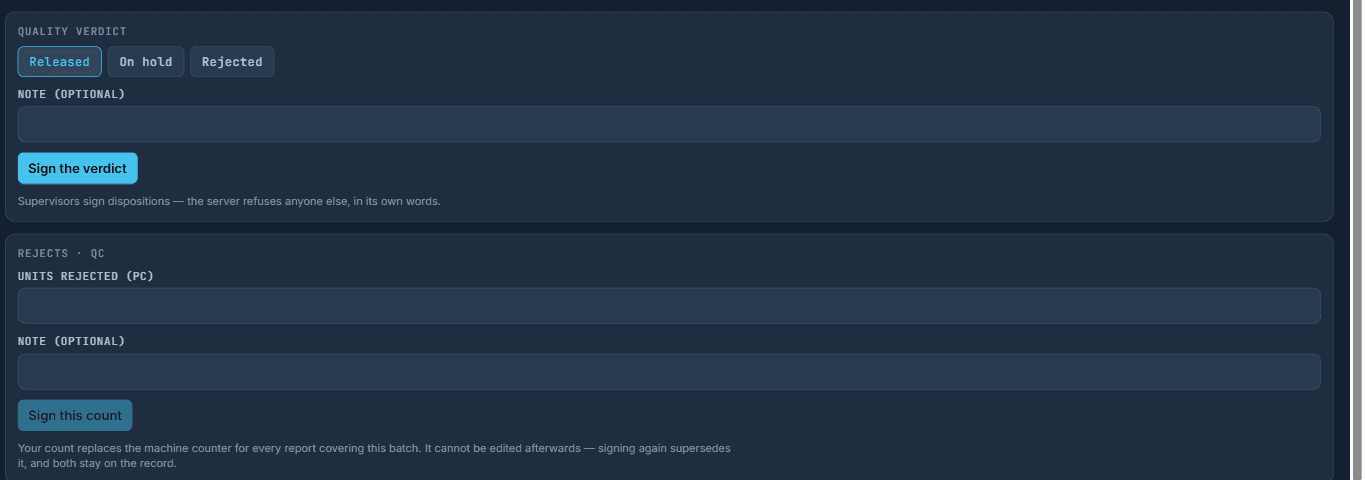
EMS · Beverage Line 7 · the two signatures
where the verdict is signed: the batch record's two signatures, and the count quality signs against the machine's own
  1. The reject count, first passThe count comes off the line's own counter, taken from the count point furthest down the flow.
  2. The signed count winsThe lab signs the verdict on the batch record; the signed count replaces the counter for that batch and the period redraws.
  3. A verdict after the shift closedSign it anyway: the period that made the product owns it, and wears a mark saying when, by whom, and from what to what.
  4. Tap the mark, read bothBoth figures side by side, so the gap closes itself instead of costing trust.
  5. No reject count at allThe page says what became of the rejects is not measured, rather than printing a zero.
  6. A unit put right stays a rejectFirst pass and every pass — so the figure cannot flatter the process it exists to expose.
  7. A verdict is added, never editedAn older signed count is superseded on the record and stays readable beside the one that replaced it, with who signed each and when.

Quality counts the first pass, every time.

  • The reject count comes off the line's own counter until a person signs a different one, and then the signed count wins. A unit that had to be put right counts as a reject the first time, so the figure cannot flatter the process it exists to expose.
  • The period that made the product owns it, and wears a mark saying when, by whom, and from what to what.
  • A verdict is added, never edited: an older signed count is superseded on the record and stays readable beside the one that replaced it, with who signed each and when. A supervisor who saw the old figure on the wall can tap the mark and read both, so a restated shift costs nothing in trust. Nothing anybody wrote is ever quietly removed.
06/08

Where the time went

Where the time went, hour by hour.

EPS · Beverage Line 7 · where the time went
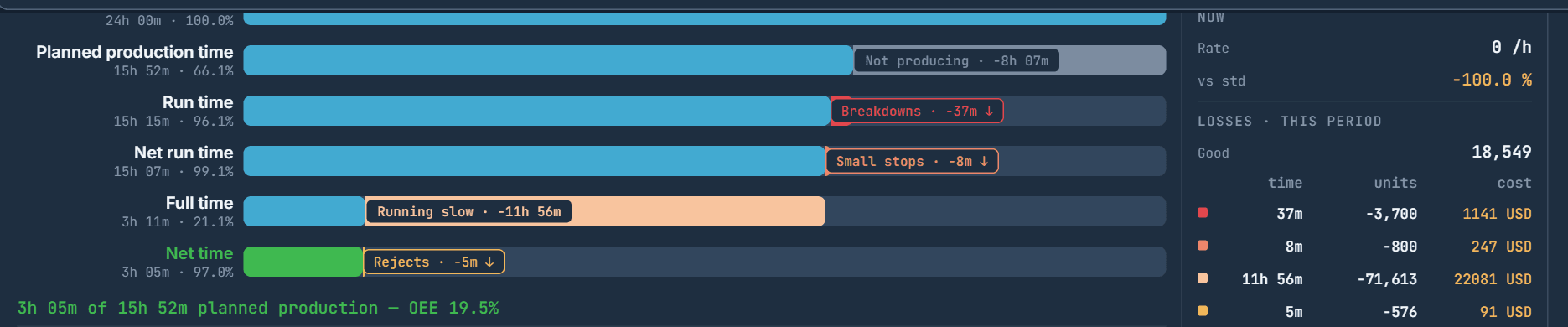
six bands, five losses, and the minutes each one took — with the same losses priced beside them
  1. The six bandsThe period's whole clock stepped down one loss at a time, so a disappointing percentage always has somewhere to point — the loss named, with the minutes beside it.
  2. Losses priced across the rowThe same loss in minutes, in units never made, and in money.
  3. Losses ranked down the cost columnThe four families ranked against each other, in one glance.
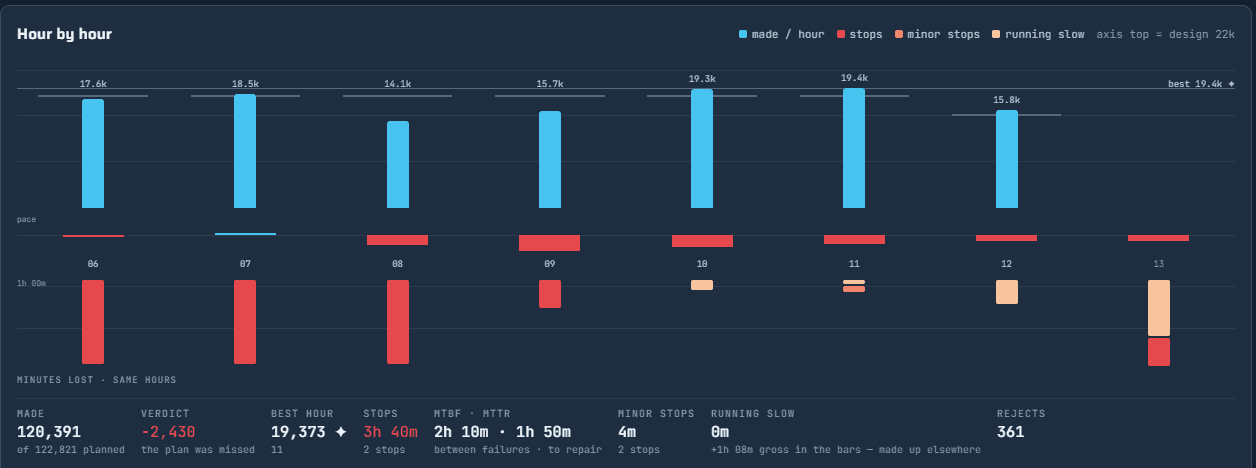
  4. The hour boardThe same period cut into equal buckets: each says what it made, what the plan wanted, and what it lost — as bars, or as a sheet worst first.
  5. The three chips under the barsMade so far, where that leaves you against plan, and where the recent pace lands.
  6. Breakdowns, longest firstWhich single stop hurt most.
  7. Protected windowsPlan the wash, changeover or shutdown in the calendar, or release the maintenance job: those hours leave the availability denominator, and a stop inside one never asks.

Seen in the product

the same period hour by hour: what was made, what the plan wanted, what was lost
the performance page as the operator opens it, the loss waterfall under the numbers

Where the time went, hour by hour.

  • Six bands take the period's whole clock and step it down one loss at a time, so a disappointing percentage always has somewhere to point. The same period is then cut into equal buckets, and each one says what it made, what the plan wanted, and what it lost.
  • Doing the right thing stops being punished by the number, and the sheet is the part a handover can be read out from on any screen, including a phone.
  • Those hours leave the availability denominator, and a stop inside one never asks.
07/08

Energy

Energy is a fold inside the record and the performance engine.

  • Not a different edition, not a per-meter licence — Energy is a fold inside the record and EPS, not a different edition or a per-meter licence.
  • Inside the record and the performance engine — Energy and cost reporting is inside the record and EPS, not a separate line.
  • Never a line of its own — Energy and cost reporting sits inside the record and the performance engine, never a line of its own.
  • What it puts on the sheet — Consumption and cost on the record, the dated rate book, downtime priced in money, per-batch used versus planned.
  • The question it answers — The energy bill, a sustainability report, a cost-per-unit question from finance.
  • Named among the nine — Energy is one of the modules the corpus names, and on this site it is presented inside EPS and Enterprise Reporting, never bought on its own.

Energy is a fold, not a module.

  • The same loss in minutes, in units never made, and in money — the losses card prices a row across, and ranks them down the cost column.
  • Energy and cost reporting is inside the record and EPS, not a separate line.
08/08

The handover, one press

The handover, printed and signed in one press.

Reports · Beverage Line 7 · the shift review, on paper
the same record as it comes off the paper
  1. The handover on paper, in one pressThe window you are reading becomes a document with a number, a seal and a place in the archive.
  2. DesignThe page's own parts, bound to real tags: the two OEE tiles, the six bands, the hour grid, the loss ranking and the downtime table.
  3. ComputeOn the server, in the site's own clock, over exactly the window on the dial: a shift, a day, a month, one job, or two instants cut by hand.
  4. SealFrozen on arrival, given a document number and a fingerprint. Press again and you have a second document beside the first, never a refresh.
  5. SignBy name and capacity, proved with the signer's own password, bound to the run's seal, never edited and never withdrawn.
  6. DeliverOn the plant's letterhead in three languages, e-mailed to the list, filed as a PDF, exported as a table.
  7. The three zeros0 report servers · 0 third-party licences · 0 seats to read: no reporting product, no rendering licence, no designer bought separately. It is inside the platform.
  8. Where paper and screen differWhere a job window makes the two disagree about what the rate is called, the paper is the one telling the truth.

The whole module fits in a hand

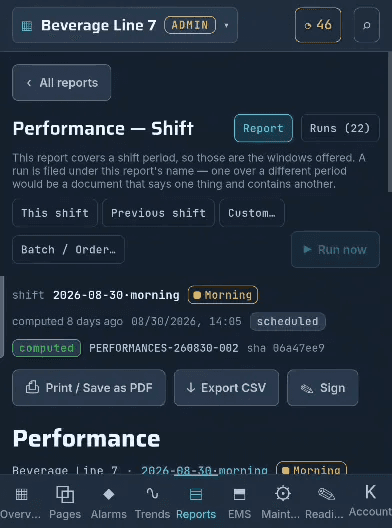
the phone · the shift report
the shift report on a phone
the shift report, read off the phone at the line
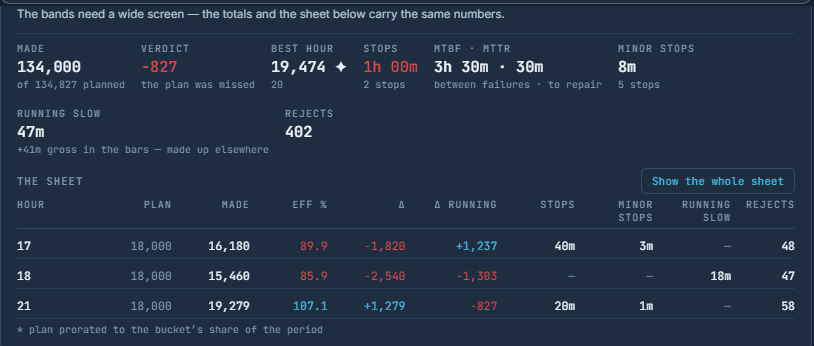
the narrow sheet
a narrow screen keeps every number: the chips carry the period, the sheet carries the hours
  1. The operatorThe door, and the card at the restart: what is waiting rides on the chip in the top bar, and the answering card opens where he is standing, not where a desk is.
  2. The supervisorThe sheet, worst first: the hours ranked by what they lost, and the shift report beside them. The handover is read off the phone, at the line.
  3. The managerThe same shift report: the document the shift closed with, and a trend under it. The number reaches him before the meeting does.

The handover, printed and signed in one press.

  • The window you are reading prints through the same engine that prints your batch certificates. One press, and the shift is a document with a number, a seal and a place in the archive.
  • The paper is the same calculation as the screen, and where a job window makes the two disagree about what the rate is called, the paper is the one telling the truth.
  • The same application, sized for a hand: nothing to install, nothing licensed per screen, three languages including right-to-left Arabic. On a phone the module has one door, and it is always in the top bar.
  • On a narrow screen the bars are dropped and every number is kept, so nothing is hidden from the person who happens to be holding a phone.

And what no other platform does like us

EPS · Beverage Line 7 · the two OEEs
two fair questions, two numbers, both true on the same day
EPS · Beverage Line 7 · the restart card and the backlog
the card that opens by itself when the line comes back — and the backlog behind it, all time, dearest first
  1. One calculation, on the server, for every screenThe wall tile, the synoptic number, the report block and the exported table are the same arithmetic, and cannot disagree.
  2. Asked once, at the restart, in two tapsNobody is ever interrupted while the line is down, and the short stops are never a popup.
  3. The loss is filed against the machine that caused itNot against the one that stopped.
  4. A backlog no period can hideEvery stop nobody has named waits in one list, from commissioning to this minute, ranked by what it cost; change the period and the list does not move.
  5. Forty small stops named in one actDrag the stretch, one reason, Record — with the count and the cost shown before the write.
  6. Two honest OEEsOne number cannot answer two fair questions, so the page prints both; and neither of them is the flattering one.
  7. Quality counts the first pass, every timeA unit that had to be put right counts as a reject the first time, so the figure cannot flatter the process it exists to expose; and a verdict is added, never edited.
  8. Doing the right thing stops being punishedPlan the wash or release the maintenance job and those hours leave the availability denominator; a figure the plant never declared prints as a dash, never a flattering zero.