

SCADA Open Platform

Capability 02 · Execution Manufacturing System

The line runs its own orders.

The execution system on the SCADA's own database: the plant model, the signed recipe, the calendar, the batches and the record — one database for the whole plant.

Everything it does, before any page explains any part of it:

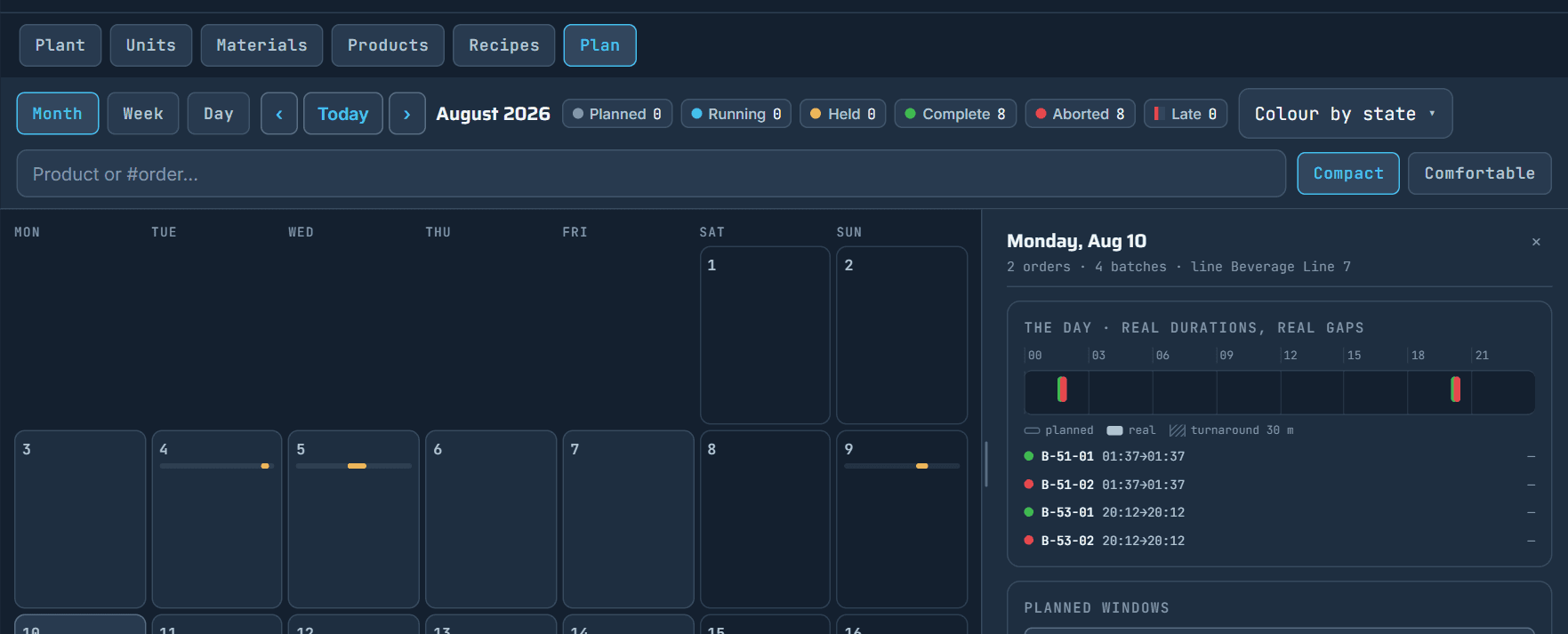
EMS · the plan · one month, one day opened
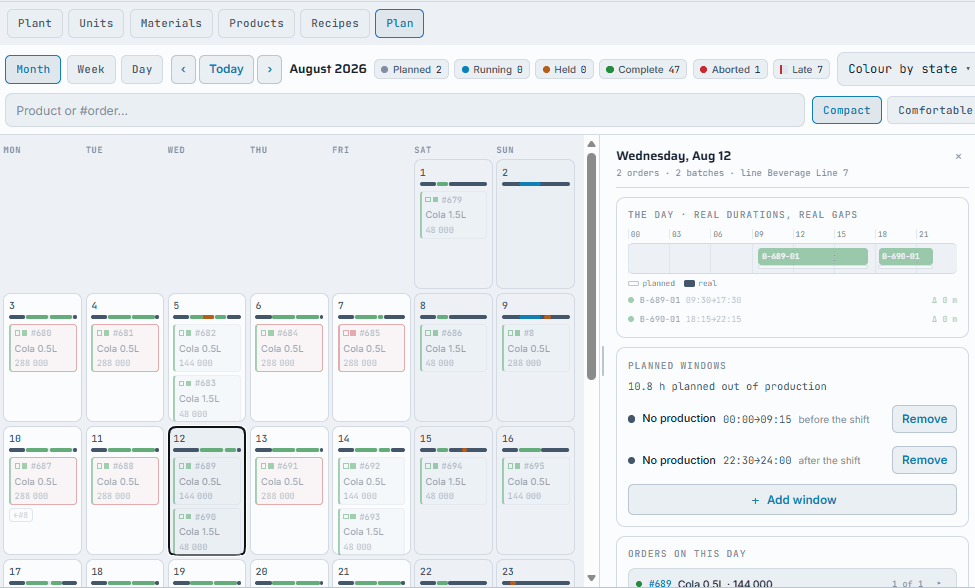
The plan · a month of orders on one line, one day opened: two orders, two batches, the real windows against the planned ones
  1. The plant is described oncethe batch vessel sizes the batch, the last stage's counter gives the good count; nobody types a quantity.
  2. The formula is signed before the plant may run itapproving a new version retires the old in the same breath, and every batch keeps the copy it ran with.
  3. One press mints the orderevery batch, its window and the line's own tags; a wash, a changeover or a shutdown is planned, not suffered.
  4. Nobody presses startthe line begins and ends its own jobs from two signals, stamped with the plant's own clock.
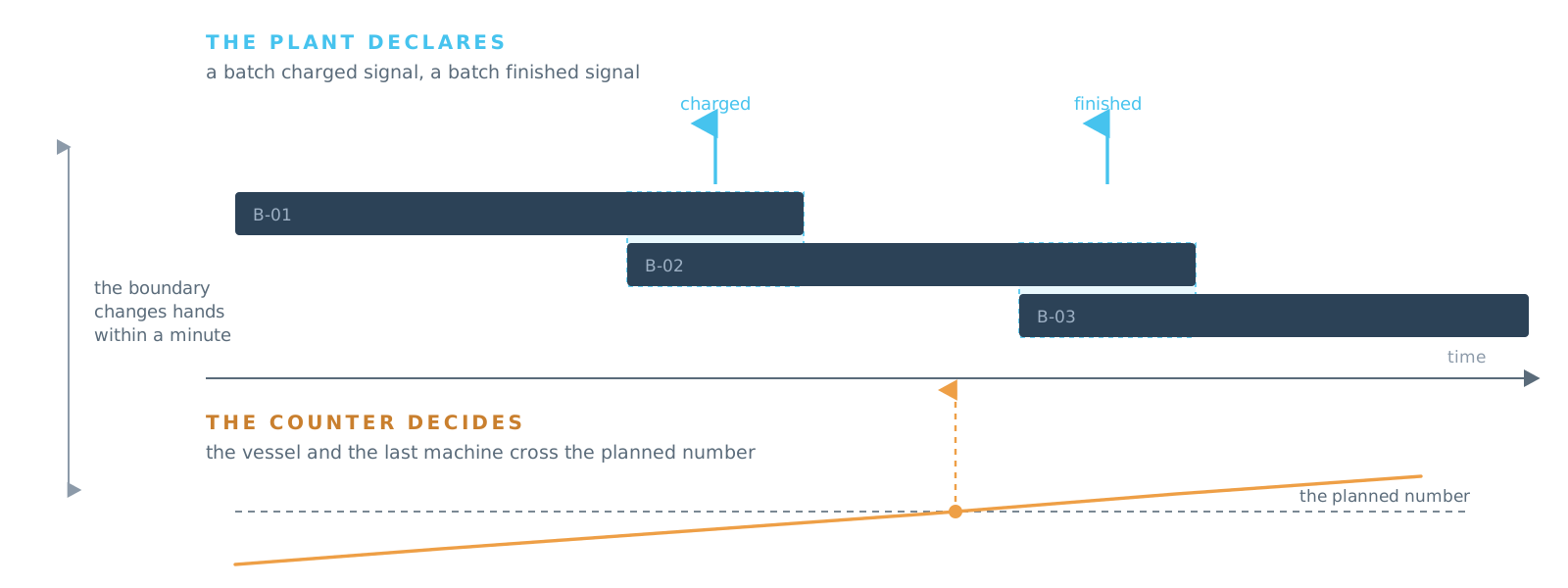
  5. Batches overlap, because lines doand you choose who decides a boundary, the plant or the counters, and change it live within a minute with no restart.
  6. Every number says who measured itcounted, declared, or held by the arithmetic; the lab's signed count outranks the machine counter and both stay on the record; what cannot be known stays blank, never zero.
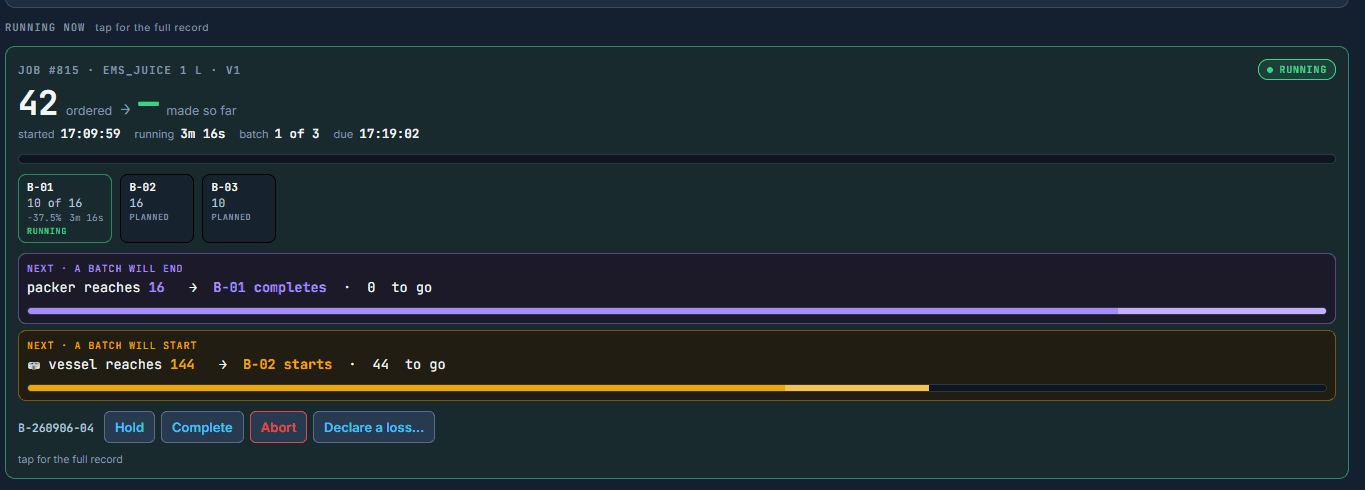
  7. The board an operator can read from the aisleone card per job, the batches as chips, the next boundary forecast — and the Quality door signed from the same screen.
  8. No second store, no batch server, no line of code at the edgethe certificate prints from the engine that prints the shift handover.

You want it, the line already knows how.

  • You want
  • What SOP does
  • The door
You wantWhat SOP doesThe door
The plant written down once, in the order the product travelsEvery machine takes a level and a stage, and the line reads its own shape back to youthe engineer's EMS · Plant
One vessel to decide how big a batch isMark it the batch vessel with its capacity, its unit and what it holds. The batch size follows; nobody types a quantityPlant · the machine card
The good count to come off the right machineName the last stage and point it at its counter. Every batch end and every yield figure is read therePlant · the machine card
A catalogue the plan can do arithmetic withMaterials carry what they are, what one of them is, what is on hand and the density that lets weight and volume crossthe engineer's EMS · Materials
What the line makes, and how it is packedA product carries its base unit, what one piece holds, and a ladder of package sizes, biggest firstthe engineer's EMS · Products
A formula the plant may not run until quality signs itDraft, in review, approved. A supervisor approves and signs; approving retires the one before itthe engineer's EMS · Recipes
A second formula for the same product, running beside the firstGive the recipe its own name and its own timeline. One line can hold severalEMS · Recipes
Next week on a calendarPick a day, one recipe, one number, one start time. The order, every batch, its window and the line's own tags are minted in one pressthe engineer's EMS · Plan
A wash, a changeover or a shutdown to be planned, not sufferedDeclare the window on the day. The plan lays the batches around it and the performance number honours itPlan · the day panel
The line to start and finish its own jobsName the signal that rings when a job begins and the one that rings when it is done. A planned order then begins by itselfPlant · the line's truths
The plant to say when a batch is charged and when it is finishedDeclare those two signals and the plant decides. Leave them alone and the vessel and the last machine's counters decide insteadPlant · the line's truths
What is running now, what is next, and how far it has to goThe board draws it: one card per job, its batches as chips, and the machine and number the next boundary is waiting onthe operator's EMS · Jobs
A batch that came out off plan to find youSet a tolerance and a time limit on the job. A batch outside either turns amber, shows its own arithmetic and asks one supervisor for one signatureJobs · the job settings, then the chip
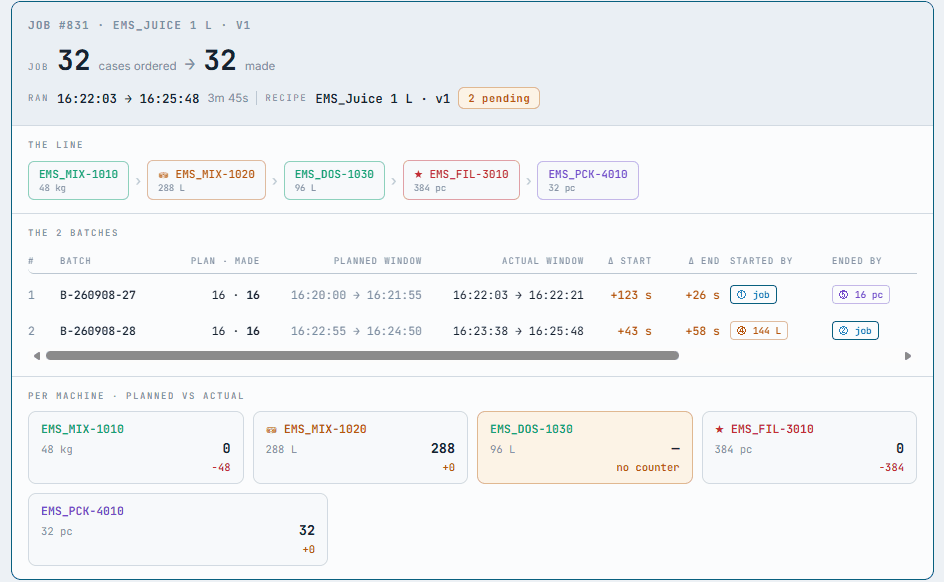
The whole job read back, batch by batch, and signedTap the card. The record opens in place: what moved every boundary, planned against actual per machine, planned against used per material, then the two signaturesJobs · the record

Everything above is one module on the database the SCADA already writes. There is no second store, no batch server and no line of code at the edge.
01/07

The plant model

The plant is described once.

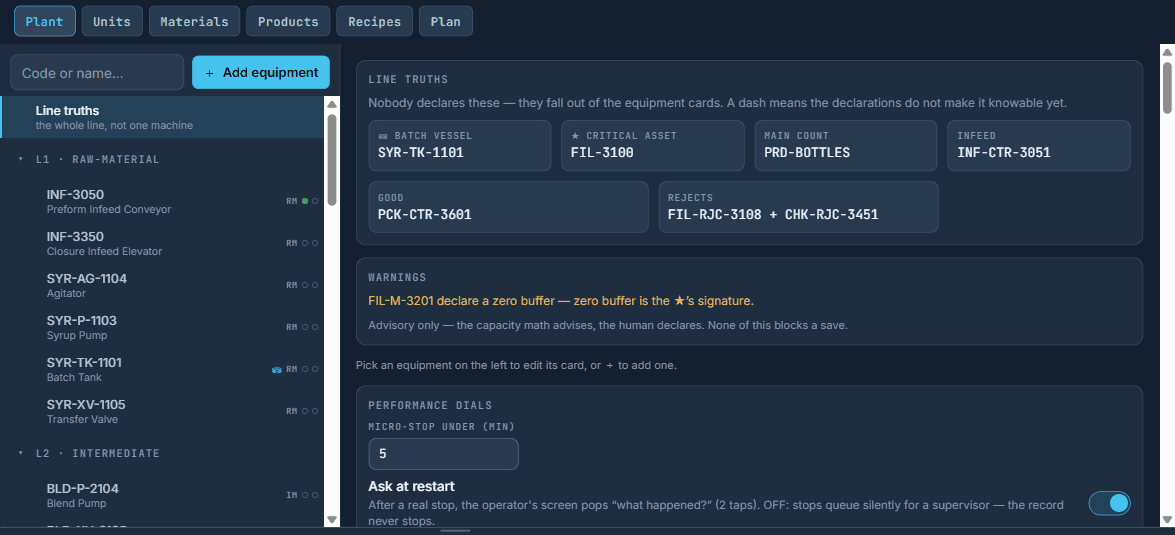
EMS · Beverage Line 7 · Plant
the plant tree, and the facts that fall out of it: the vessel, the machine the good count comes off, the counters
EMS · Beverage Line 7 · the material card
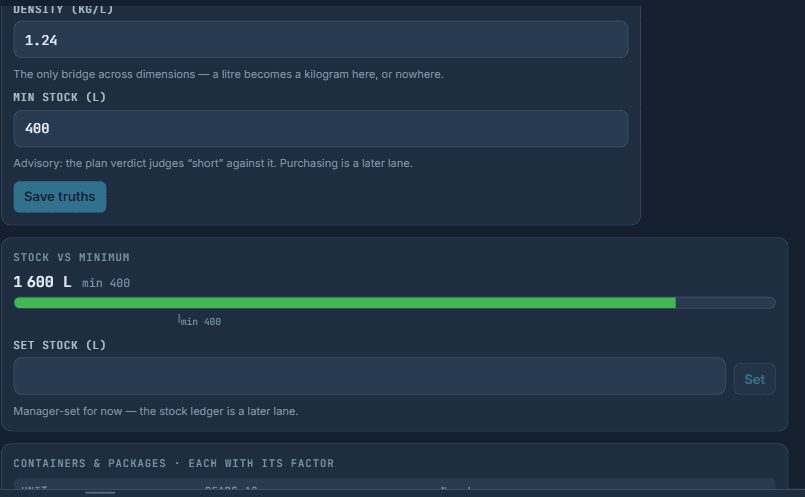
a material carries what it is, what one of it is, what is on hand against its minimum, and the density that lets weight and volume cross
  1. Plant tree, level and stageA machine joins the line and takes its place, in plant order, on every plan, every record and every report.
  2. The batch vesselMark one vessel with its capacity, its unit and the material it holds; the batch size follows from the vessel, nobody types a quantity.
  3. The last stage and its counterName the machine the good count comes off; every batch end and every yield figure is read there.
  4. Materials that can do arithmeticA material carries what it is, what one of it is, what is on hand against its minimum, and its density.
  5. Density crosses weight and volumeA powder bought by weight and dosed by volume; without the density the plan refuses rather than guesses.
  6. A material made upstreamDeclare it made and name the line that makes it; the intermediate is modelled without a second catalogue and without a spreadsheet between them.
  7. The minimum on a materialThe catalogue shows what is short, and the shortfall is printed beside the order before it is planned.
  8. Products and their packing ladderA product carries its base unit, what one piece holds, and a ladder of package sizes, biggest first.
  9. Not measured, never zeroA machine with no counter reads not measured on the record; what cannot be known stays blank.

The plant is described once.

  • The execution system does not ask you to describe your plant again: it opens on the machines the SCADA already reads. You say which one sizes a batch, which one the good count comes off, and what each counter is counting, and the line reads its own shape back to you.
  • The batch size follows from the vessel. Nobody types a quantity.
  • A machine with no counter reads not measured on the record, never zero. What cannot be known stays blank, so nobody is asked to trust a figure the plant never made.
  • Without it the plan refuses rather than guesses — the density that lets weight and volume cross.
02/07

Products, recipes, the quality door

The formula is signed before the plant may run it.

EMS · Beverage Line 7 · Recipes
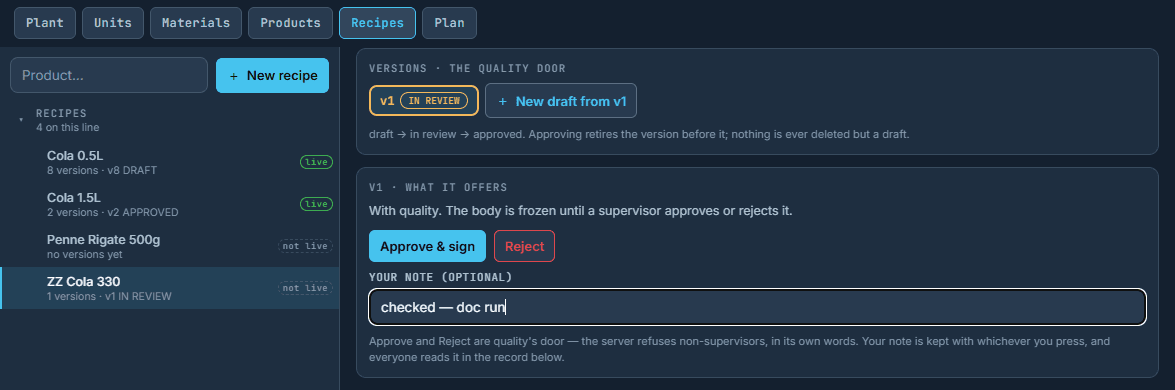
the quality door: draft, in review, approved, and the note kept with whichever was pressed
EMS · Beverage Line 7 · the recipe sheet
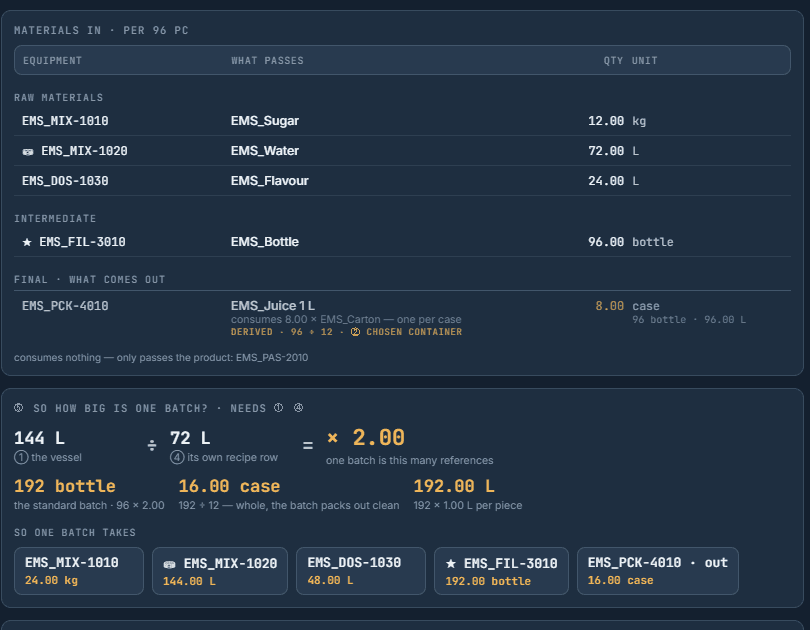
the recipe sheet: what each machine takes in and what comes out, grouped the way the product travels, and how big one batch is
  1. The recipe itselfSays what goes in, on which machine, into which container and at what rate, and is frozen into every batch it makes.
  2. Draft · in review · approvedA new version is written and sent to quality; approving the new one retires the old one in the same breath, and every batch keeps the copy it ran with.
  3. A supervisor signsNobody may run an unsigned formula; the server refuses anyone but a supervisor, in its own words, and the note is kept beside the signature.
  4. Only a draft is editableA draft is the only thing that can be edited and the only thing that can be deleted; everything else is kept.
  5. Two formulas for one productGive the recipe its own name and its own timeline; both live on the line, and the order picks the one it needs.
  6. The container the recipe packs intoThe batch size and the packing row are worked out from the container, and typed nowhere.
  7. Approval judges the promised rateA recipe promising a rate the line cannot hold is refused, and the refusal names the machine that cannot keep up, before a single batch is planned.
  8. A setpoint bound in the recipeSent to the machine when the batch starts, on the same audited path an operator's own setpoint takes.

The formula is signed before the plant may run it.

  • A recipe says what goes in, on which machine, into which container and at what rate, and it is frozen into every batch it makes. Nothing is edited in place after a supervisor signs it, so next month's improvement can never rewrite what happened last night.
  • Approving the new one retires the old one in the same breath, and every batch keeps the copy it ran with.
  • A draft is the only thing that can be edited, and the only thing that can be deleted. Everything else is kept.
  • The refusal names the machine that cannot keep up, before a single batch is planned.
03/07

Orders, the calendar, the job

Nobody presses start.

EMS · Beverage Line 7 · Plan
orders on the calendar: each batch with its own expected window, laid one after another
  1. One press mints the orderPick a day: one recipe, one number, one start time — the order, every batch, each batch's window and the line's own tags are minted in one press, laid one after another with the turnaround between them.
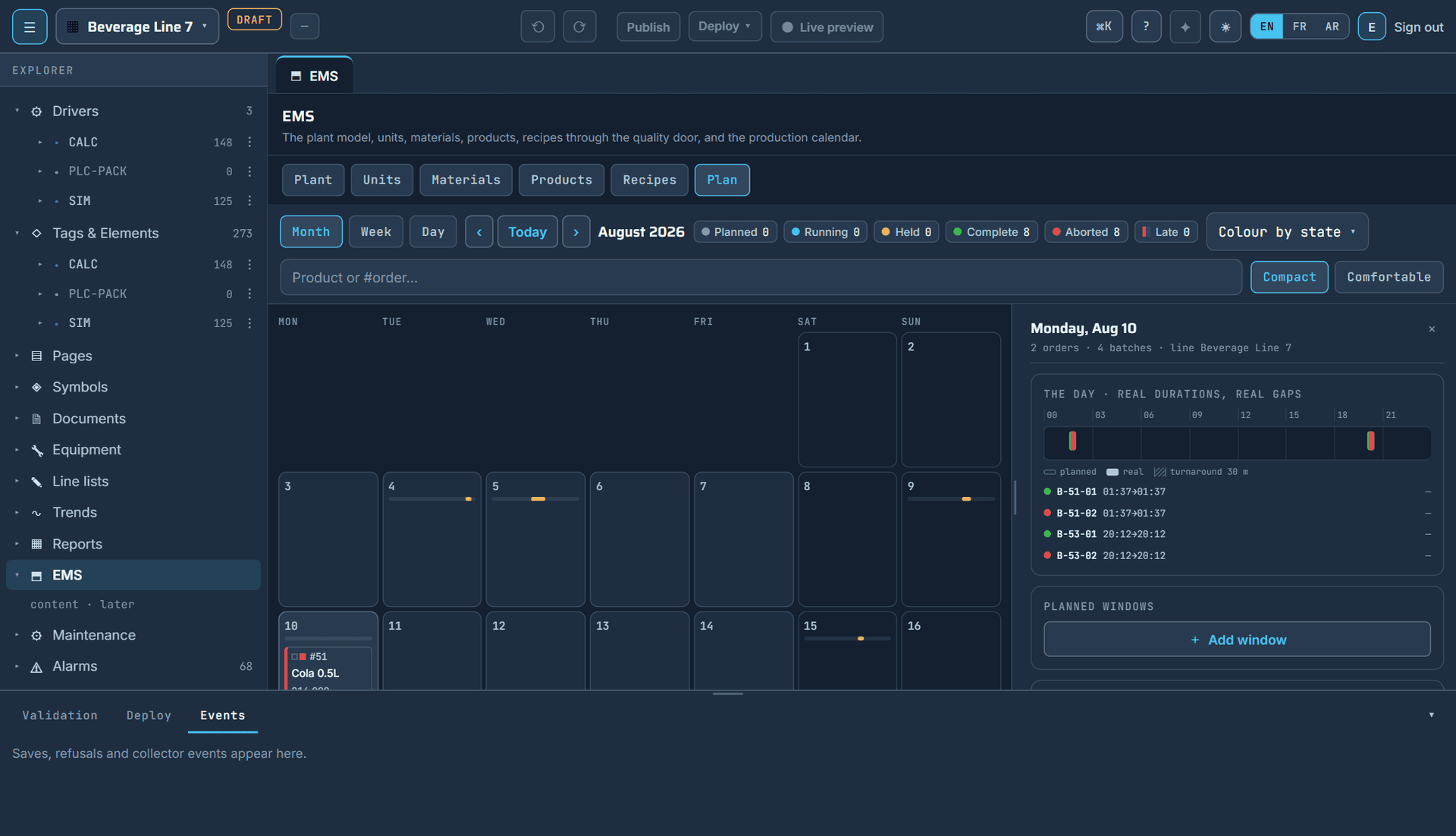
  2. A planned windowDeclare a wash, a changeover or a shutdown on the day; the plan lays the batches around it and the availability number honours it instead of punishing it.
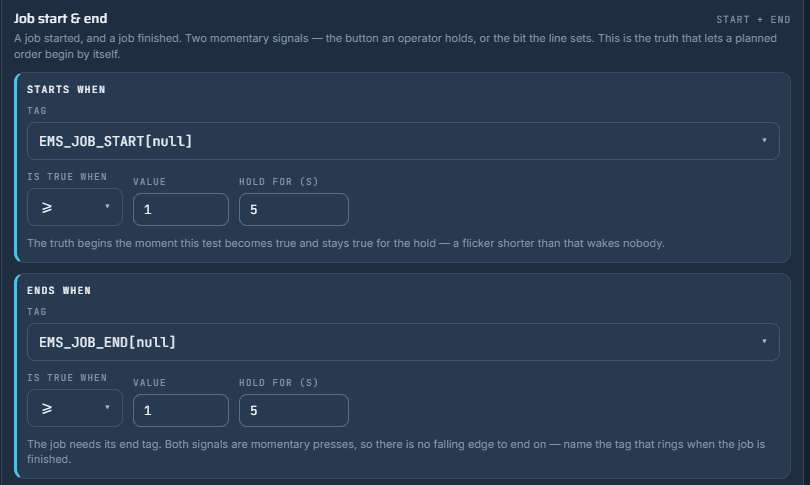
  3. The two job signalsName the signal that rings when a job begins and the one that rings when it is finished; a planned order starts and ends by itself, stamped with the plant's own clock.
  4. The wait boxWhen the line has not picked a job up, it says why before it offers anything; where it can, one press raises the line's own start signal.
  5. The line's own questionWhen two planned orders could match the signal that just came, the line asks on the operator's own screen; the job starts at the signal's own moment.
  6. Reschedule, annotate, replace, cancelAn order can move or go while its batches are still planned; a plan that has already run is never rewritten, and the change is on the record.
  7. An order with no planned timeCan never be picked up, and the board says so rather than failing quietly.

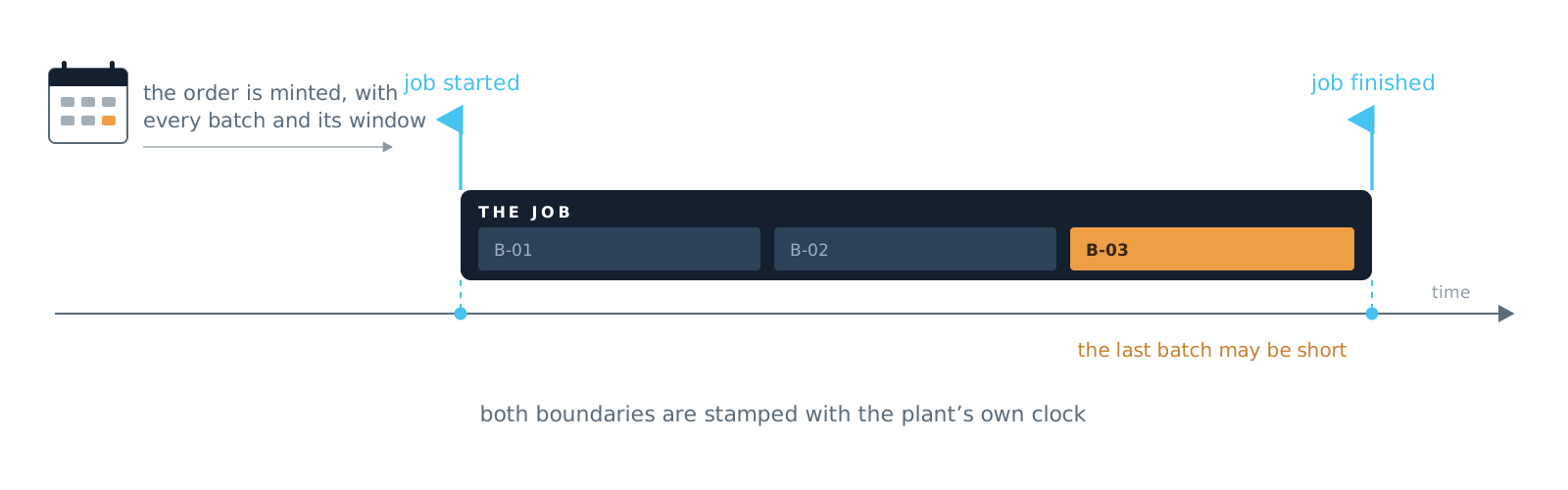
one press mints the order; two signals open and close the job

The mintone press on the calendar writes the order, its batches and their windows
Job startedthe pulse the plant raises opens the job
The batchesthree bars inside the job, the last one tinted
Job finishedthe pulse that closes it, on the plant's own clock

Seen in the product

the two signals the line begins and finishes on
the calendar in the editor: the state chips — planned, running, held, complete, aborted, late — and the day panel with the real durations against the planned ones

Nobody presses start.

  • Orders live on a calendar, and minting one writes the order, every batch, each batch's own expected window and the line's own tags in a single press. Then two signals do the rest: the line opens its job when the plant says a job began, and closes it when the plant says it is done.
  • A planned order starts and ends by itself, stamped with the plant's own clock and not the moment somebody noticed.
  • An order with no planned time can never be picked up, and the board says so rather than failing quietly.
  • A plan that has already run is never rewritten, and the change is on the record. Nobody edits a record to make a job run.
04/07

Batches and the boundary

Batches overlap, because lines do.

EMS · Beverage Line 7 · Jobs
two batches running at once on one line: one draining at the packer, the next charging at the vessel
  1. Batches overlap by constructionThe engine opens the next batch at the vessel and closes the previous one at the last machine; two batches run at once on the board.
  2. The plant declares the boundaryDeclare a batch charged signal and a batch finished signal; every boundary is a pulse the plant raises, and any batch can come out short or over.
  3. The counters take the boundaryLeave those two signals alone: the vessel and the last machine's counters decide, and only the last batch of a job can come out short.
  4. Change who decides, livePark the two signals or declare them; the boundary changes hands within a minute, with no restart and nothing to reconfigure.
  5. A counter reset or wrapIt goes to zero and keeps counting; the total before the reset carries forward.
  6. A meter that drops outA reading that is not good never judges and never counts, so a comms loss invents no boundary.
  7. Batches tile the jobEach batch's made and used are read off the segments that tile the job, so the batches always add up to the job's own count.

the plant declares the boundary with a pulse, or the counters take it when the planned number is crossed

Three batchesoverlapping at their ends, because lines do
The plant declarestwo pulses above the bars
The counter decidesa counter track crossing its threshold, below
The boundary changes handswithin a minute, with no restart

Batches overlap, because lines do.

  • The filler is still draining one batch while the vessel charges the next, so the board shows both of them running. You choose who decides the boundary between them, and you can change your mind without stopping the line.
  • The boundary changes hands within a minute, with no restart and nothing to reconfigure.
  • Each batch's made and used are read off the segments that tile the job, so the batches always add up to the job's own count.
  • A reading that is not good never judges and never counts, so a comms loss invents no boundary.
05/07

The batch record

Every number says who measured it.

EMS · Beverage Line 7 · the record
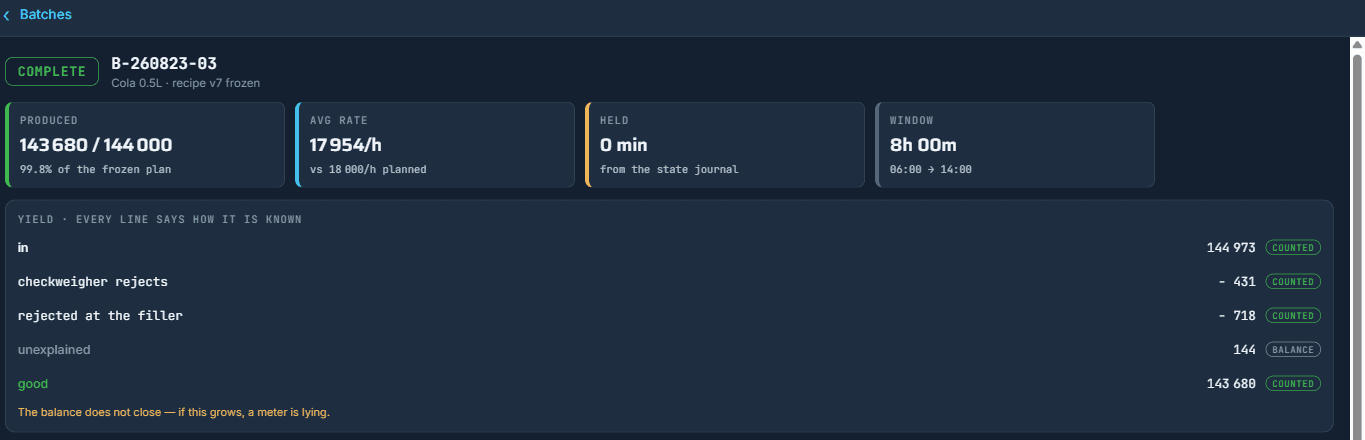
the record: every line says how it is known, and the balance that tells you when a meter is lying
EMS · Beverage Line 7 · the two signatures
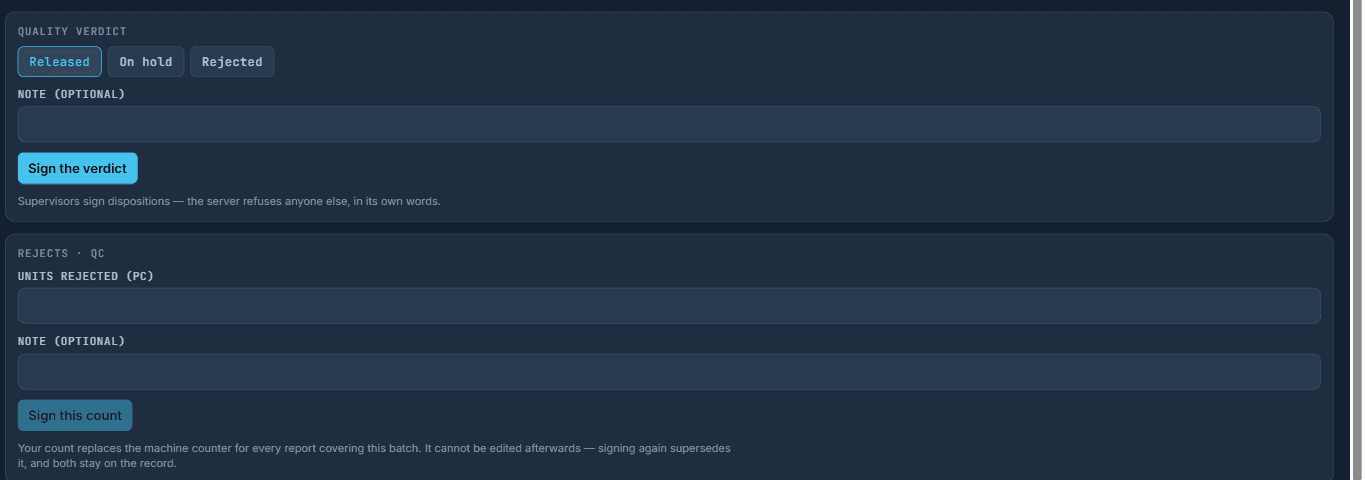
the two signatures that close a batch: the verdict a supervisor signs, and the count quality signs against the machine's own
  1. Every number says how it is knownCounted by a meter, declared by a person, or held by the arithmetic — on the same row as the figure.
  2. The yield card and its balanceThe record's balance tells you when a meter is lying.
  3. The lab's signed reject countSign the count: the signed number outranks the machine counter on every report covering that batch, and both stay on the record.
  4. Tolerance and time limit on the jobA batch outside either turns amber, shows its own arithmetic and asks one supervisor for one signature: accept as it is, hold, or reject.
  5. No spreading a shortfall forwardThere is no such button, and there never will be; a signed plan is immutable and a restatement is recorded where it happened, never re-planned.
  6. Planned against used, per materialThe plan froze the material rows when the order was minted; each batch prints planned against used, material by material, marked on plan, off, or not measured.
  7. When judgement happensQuantity is judged only when a batch is finished, and time while it runs.

Every number says who measured it.

  • The record's one habit is that no number appears without saying where it came from: a meter counted it, a person declared it, or the arithmetic is holding it. That is what turns a batch record from a printout into evidence.
  • The signed number outranks the machine counter on every report covering that batch, and both stay on the record.
  • Quantity is judged only when a batch is finished, and time while it runs, which is what keeps the board quiet on the forty batches that were fine.
  • A signed plan is immutable. A restatement is recorded where it happened, never re-planned. There is no such button, and there never will be.
06/07

The jobs board and the phone

The board an operator can read from the aisle.

EMS · Beverage Line 7 · Jobs
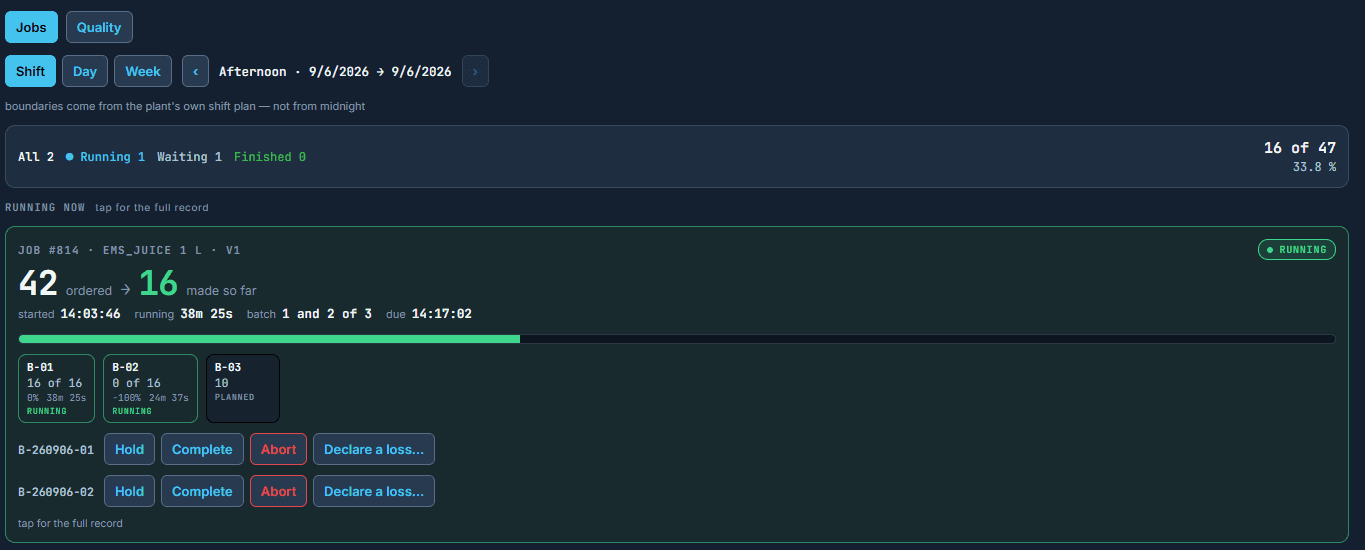
the running job with the machine and the number the next boundary is waiting on
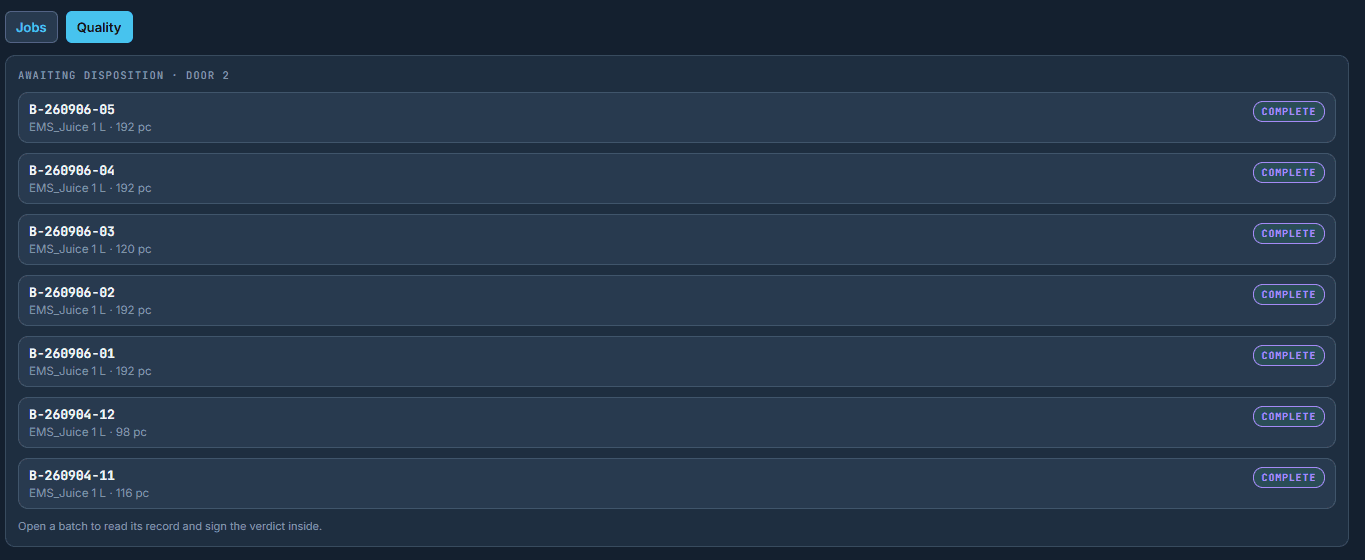
EMS · Beverage Line 7 · the Quality door
the Quality door: everything still unsigned, signed from the same screen while the line runs
  1. The jobs boardOne card per job: ordered against made, the batches as chips, and the period's own tally.
  2. The next-boundary forecastNames the machine, the number it is heading for, what happens when it gets there, and the distance left.
  3. The forecast stays honestIt goes quiet on a boundary the plant declares by signal, because then the counter decides nothing.
  4. The plant's own shift planThe night shift stays one period across midnight, and a job carried in says which shift it started in.
  5. One row per live batchHold a batch, end it, or declare a loss on that batch's own row, so a move can never touch the wrong one under overlap.
  6. The whole job read backTap the card: the record opens in place — what moved every boundary, planned against actual per machine, planned against used per material, then the two signatures.
  7. The Quality doorWhat is waiting for a verdict is listed, and it is signed from the same screen while the line runs.
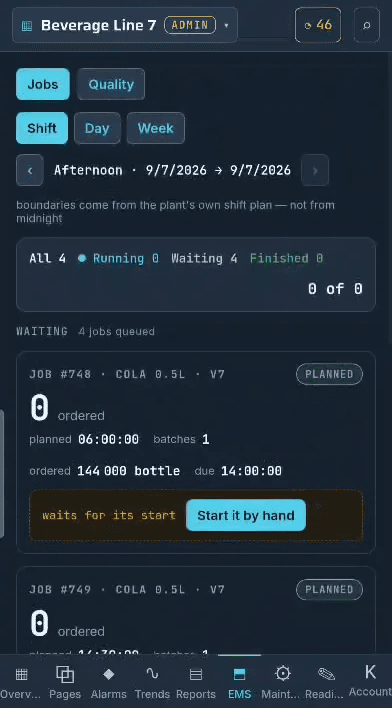
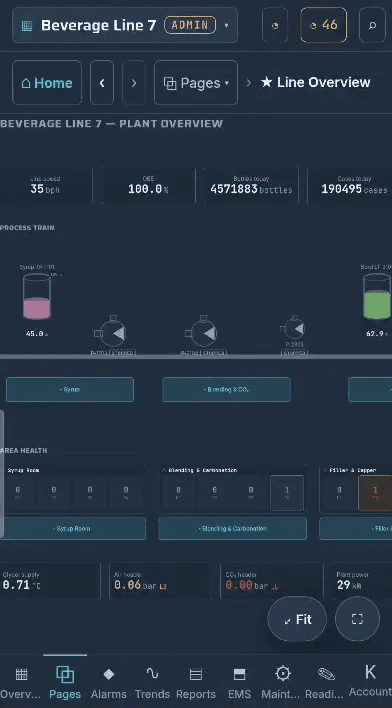
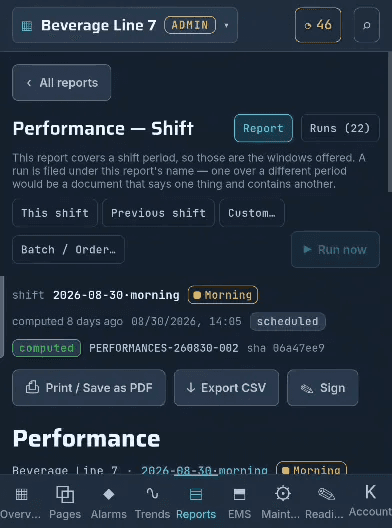
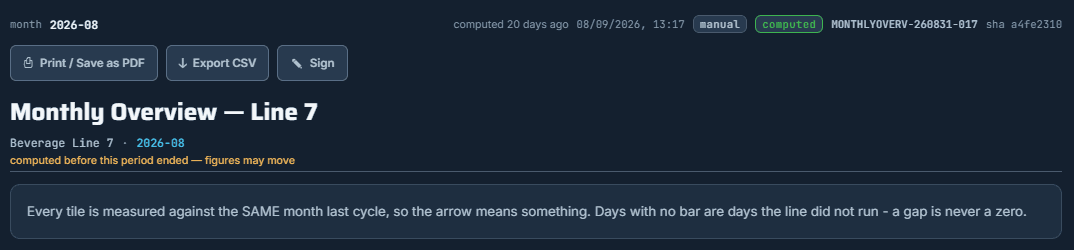
  8. The same screen on a phoneThe board, the chips and the record, with nothing installed and no second application to buy.
One job · cases ordered and made, the recipe it ran with, the line's five machines, the two batches planned against actual

The same application, sized for a hand

the jobs board, on a phone
the jobs board
the line the job is running on, on a phone
the line the job is running on
a report, on a phone
a report

The board an operator can read from the aisle.

  • The operator's screen is one card per job, its batches as chips, and a forecast the floor has never had: which machine reaches which number, and how far it has to go. The same screen, sized for a hand, is the supervisor's phone.
  • The forecast goes quiet on a boundary the plant declares by signal, because then the counter decides nothing, and a panel that cannot be honest says nothing at all.
  • The board, the chips and the record, with nothing installed and no second application to buy.
  • The same application, sized for a hand. The jobs board, the line the job is running on and a report — nothing installed, nothing licensed per screen.
07/07

The certificate, from the engine

The certificate prints from the engine that prints the shift handover.

Reports · Beverage Line 7 · the batch certificate
the reader: the document number, the hash, print, export and sign
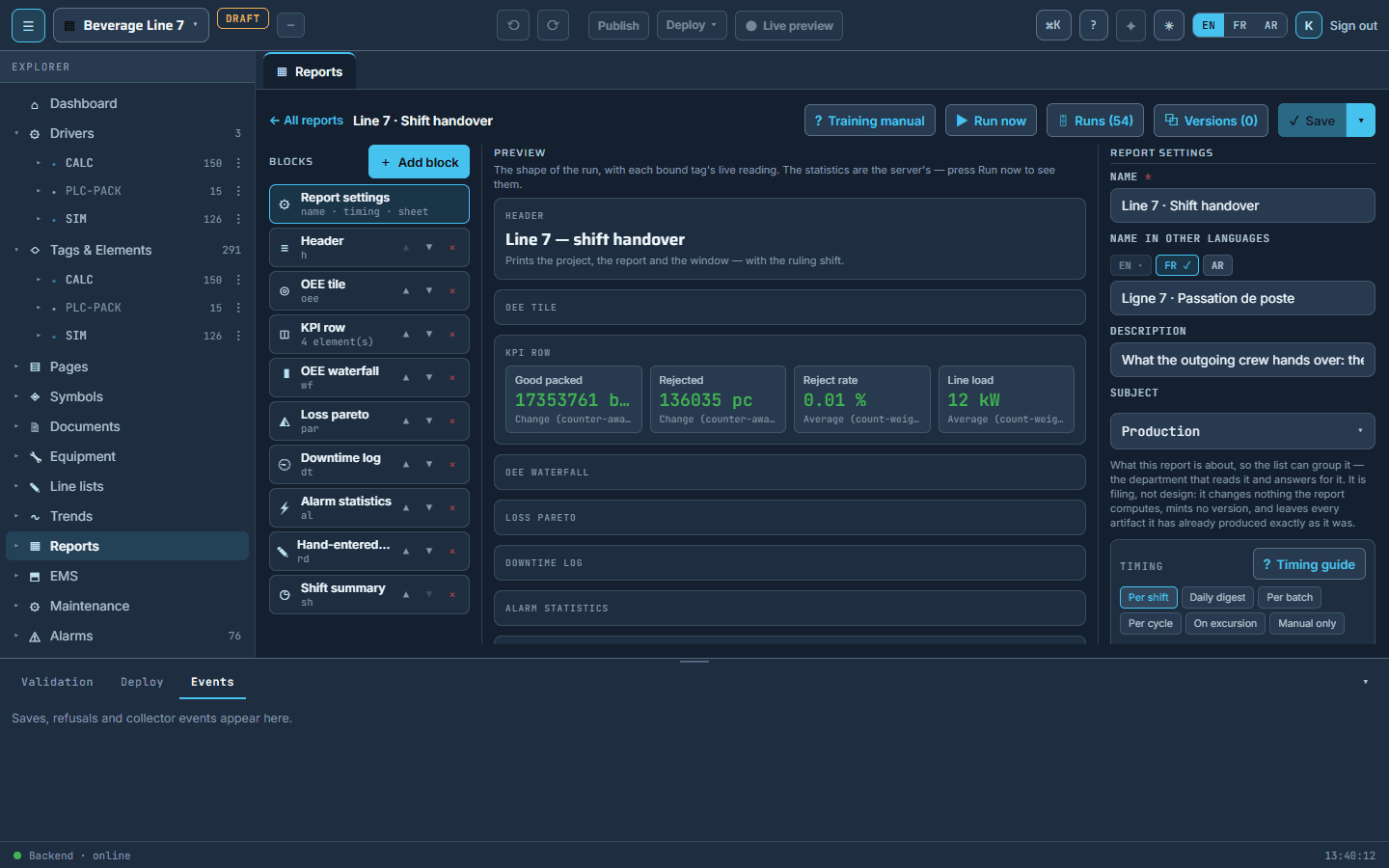
Reports · Beverage Line 7 · the designer
the designer, where the batch certificate is drawn once against real signals
  1. A batch is a report windowThe certificate exists the moment the batch closes, computed over exactly the thing that was made.
  2. DesignBlocks bound to the line's own signals: tiles with targets, period tables, trends with their limits, alarm journals, the batch blocks, consumption and cost.
  3. ComputeOn the server, in the plant's own clock: every shift, day, week or month — or every batch, every order, every maintenance job. Nobody presses anything.
  4. SealFrozen on arrival, numbered, hashed. Run it again and you get a second document beside the first, never a refresh.
  5. SignBy name and capacity, proved with the signer's own password, bound to the hash, never edited and never withdrawn.
  6. DeliverPrinted on the plant's letterhead in three languages, e-mailed to the list, filed as a PDF, exported as a spreadsheet.
  7. The three zeros0 report servers · 0 third-party licences · 0 seats to read: every operator, supervisor, planner and auditor reads, prints, exports and signs.
  8. Ready-made sheets, yours to changeThe batch certificate, the shift handover, the maintenance record, the audit sheet for critical equipment, the excursion report, the monthly review.
  9. A blank certificate is refused at designA report that would print a blank certificate is refused while it is being designed.
the same record as it comes off the paper

The certificate prints from the engine that prints the shift handover.

  • A batch or an order is a report window, so the certificate exists the moment the batch closes. What the incumbents sell as a separate report server with its own designer, its own database and its own licence is an organ of the same platform, computing on the same rows the line wrote.
  • Page x of y on every sheet, an end marker, a document number, and a hash you can verify outside the building. A report that would print a blank certificate is refused while it is being designed.
  • A released maintenance job books a window the production calendar already plans around. The batch certificate prints from the engine that prints the shift handover. A reject count signed by the lab outranks the machine counter, and the period says it was restated. One security model reaches the sheet. Nothing to connect, because there is nothing to connect.

And what no other platform does like us

EMS · Beverage Line 7 · two batches at once
two batches running at once on one line: one draining at the packer, the next charging at the vessel
EMS · Beverage Line 7 · the record and its two signatures
every line says how it is known, the balance that tells you when a meter is lying — and the two signatures that close a batch
  1. Not a second systemThe module you have been reading is arithmetic over rows the SCADA already writes. Same pages, same alarms, same audited command path, same engineers' browser — and no store, server or connector between the plan and the line.
  2. Nobody presses startThe line opens its job when the plant says a job began and closes it when the plant says it is done, stamped with the plant's own clock and not the moment somebody noticed.
  3. Batches overlap, because lines doThe filler is still draining one batch while the vessel charges the next, so the board shows both of them running.
  4. Change who decides a boundary, while the line runsPark the two signals or declare them and the boundary changes hands within a minute, with no restart and nothing to reconfigure. A system that lets you do that is not a system that was bolted on afterwards.
  5. Every number says who measured itA meter counted it, a person declared it, or the arithmetic is holding it. That is what turns a batch record from a printout into evidence.
  6. The signed count outranks the machineThe lab's signed reject count outranks the machine counter on every report covering that batch, and both stay on the record.
  7. One tag, through every moduleA counter that ends your batches is bound in a recipe, a page, a trend, an alarm and a report block; before anyone re-addresses it, the Tag Lens shows every one of them. We know of no other platform that follows one tag through every module of the plant like this.
  8. The certificate prints from the engine that prints the shift handoverNo second store, no batch server, no line of code at the edge.